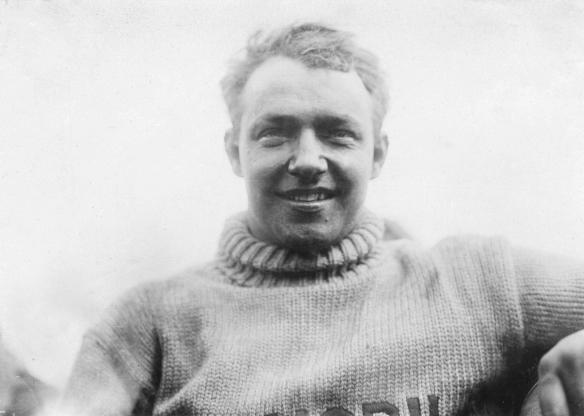
George Robertson
Winner of the 1908 Vanderbilt Cup Race
Nationality: American
Born: November 22,1884 New York
Died: July 3, 1955 71 Years
George Robertson was the first American to win a Vanderbilt Cup Race. He drove "old 16" Locomobile to victory in the 1908 Vanderbilt Cup Race, the first race to be held on the Long Island Motor Parkway.
Related Posts
-
Apr 21
2026
Mystery Friday Foto #16 Solved: Broadway Actress Elsie Janis Was This Past Weekend’s Mystery Woman
Did you identify Elsie Janis and her connections?
-
Mar 31
2026
Mystery Friday Foto #13 Solved: A Winning Pair of Duesenbergs
Did you identify this race-winning Duesenberg race team?
-
Feb 03
2026
Mystery Friday Foto #5 Solved: A Mystery Racing Painting of George Robertson in ‘Old 16’
Peter Shriver has challenged you to identify his grandfather George Robertson in a racing painting by Peter Helck
-
Sep 23
2025
Sad News: Jerry Peter Helck has passed away at the age of 94.
Maggie Helck has informed me that her father Jerry Peter Helck passed away peacefully last Sunday at the age of 94.
-
Jul 08
2025
Mystery Friday Foto #37 Solved: ‘Old 16’ at Bridgehampton
Did you identify 'Old 16' at Bridgehampton?
-
Apr 26
2025
1908 Locomobile Vanderbilt Cup Race Mascot/Paperweight sells for $2,706 in today’s Automobilia Auction
The 1908 Locomobile Vanderbilt Cup Race Mascot/Paperweight continues to be one of the most collectible pieces of Vanderbilia.
-
Apr 12
2025
Checkmate Magazine: Days of Thunder- Long Island’s Vanderbilt Cup Races
Checkmate Magazine's feature story in its 2018 fourth issue highlighted Long Island's Vanderbilt Cup Races.
-
Dec 31
2024
Mystery Friday Foto #51 Solved: J. Walter Christie’s 1905 Vanderbilt Cup racer
Did you identify Christie's Vanderbilt Racer for the last mystery photo of 2024?
-
Sep 03
2024
Mystery Friday Foto #35 Solved: George Robertson’s Strange Accident in Vanderbilt Cup Race History
Did you identify George Robertson's Vanderbilt Cup Race wreck?
-
Jun 15
2024
InstaGRAM Report: Peter Helck: Advertising and Art Part 1— Old 16
Peter Helck was not only an eye-catching canvas painter of historic automotive events, but his artwork was also commissioned by companies to be created for magazine ads. this new series of articles will highlight these advertisements that were painted by Peter Helck.
-
Apr 09
2024
Mystery Friday Foto #14 Solved: #1 Locomobile Vanderbilt Cup Race Driver Jim Florida
Did you identify Vanderbilt Cup Race driver Jim Florida?
-
Mar 23
2024
The Irish Volunteers at the Vanderbilt Cup Races
Author and Mitchel Field historian Paul R. Martin III's wonderful excerpt from his book 'Beneath the Shadows of Wings' about the Irish Volunteers and the Vanderbilt Cup Races
-
Mar 16
2024
VanderbiltCupRaces.com cited in the “Nation of Speed” exhibit at the National Air and Space Museum in Washington, D.C.
The website has been cited as a contributor to the ongoing "Nation of Speed" exhibit, a collaboration between National Air and Space Museum and the Smithsonian’s National Museum of American History.
-
Jan 09
2024
Mystery Friday Foto #1: Solved; The Hazardous Woodbury Turn
Jena challenged you to identify this Christmas gift from her husband.
-
Oct 31
2023
Kleiner’s Korner: Miscellaneous News Concerning Vanderbilt Cup Race Drivers and Cars
Here are some miscellaneous news items reported about Vanderbilt Cup Race drivers and autos.
-
Oct 13
2023
InstaGRAM Report: Peter Helck Vanderbilt Cup Races Paintings Part 2
An up-close look into Peter Helck's Vanderbilt Cup artwork
-
Sep 26
2023
The 1906 #1 Locomobile in the AACA’s Antique Automobile Magazine
The 1906 #1 Locomobile is featured on the cover of recent AACA's Antique Automobile Magazine with images courtesy of VanderbilCupRaces.com .
-
May 15
2023
Mystery Friday Foto #19 Solved; Old 16 Locomobile celebrating the 1908 Vanderbilt Cup Race victory in Bridgeport
Did you identify this celebration?
-
Apr 10
2023
Mystery Friday Foto #14 Solved: Old 16 at the 1909 Chicago National Motor Show
The Helck Family Archives challenged you to solve this weekend's Mystery Foto.
-
Dec 12
2022
Mystery Friday Foto #50 Solved: Old 16 and four Vanderbilt Cup Race drivers and mechanicians at the 1948 Antique Auto Show
The Helck Family Collection challenged you to solve this weekend's Mystery Foto.
-
Nov 28
2022
Update: Mystery Friday Foto #48 Solved: The 1901 Riker Torpedo setting the one-mile land speed record for electrics in Coney Island
Did you identify this photo from November 16,1901?
-
Nov 01
2022
Update: Special Guest for the Long Island Motor Parkway Preservation Society Meeting at the Bethpage Public Library on Wednesday, November 2, 2022 at 7 p.m.
Time for an in-person meeting of the Long Island Motor Parkway Preservation Society.
-
Nov 01
2022
Profile of George Robertson- Winner of the 1908 Vanderbilt Cup Race
In preparation for Wednesday's Long Island Motor Parkway Preservation Society Meeting, below is a profile of driver George Robertson.
-
Oct 19
2022
A 1908 Vanderbilt Cup Race painting by Peter Helck sold at the RM Sotheby’s October auction in Hershey, Pennsylvania
Earlier this month RM Sotheby's sold a Peter Helck painting of Old 16 Locomobile and the #12 Thomas competing in the 1908 Vanderbilt Cup Race.
-
Oct 17
2022
Mystery Friday Foto #42 Solved: 1949 AACA Racing Camp dinner featuring Vanderbilt Cup Race drivers
Did you identify the famous faces in these Helck Family Collection's Mystery Fotos?
-
Sep 21
2022
The Henry Ford Archives: Race cars and artifacts from the “Driven to win: Dawn of Racing” exhibit
The Henry Ford has posted images and profiles of race cars and artifacts in their collection that were part of a recent "Dawn of Racing Exhibit."
-
Aug 24
2022
Exclusive from the Garden City Archives: Old 16 Locomobile taking a turn in the hamlet of Jericho during the 1908 Vanderbilt Cup Race
Garden City village historian Bill Bellmer has forwarded this never-before-published photo from the Garden City Archives.
-
Jul 27
2022
Kleiner’s Korner: From Vanderbilt Cup Racer to Jaguar XK120
Here's the story of how George Robertson's mechanician in the 1906 Vanderbilt Cup Race Elimination Trial 40 years later got to test drive a Jaguar XK120.
-
Jan 02
2022
Walt Gosden Article: A Vanderbilt Locomobile
Automotive historian Walt Gosden has discovered a 1918 designed and built for "Mrs. W.K. Vanderbilt."
-
Dec 11
2021
Illustration Magazine: The work of Peter Helck. (112 pages)
Tim Helck has forwarded the news that the current issue of Illustration is devoted solely to the work of his grandfather Peter Helck.
-
Nov 09
2021
Kleiner’s Korner: Three Accidents Involving Motor Parkway Celebrities
As the automobile industry brought more people to the roadways, an increase in accidents was inevitable. Originally this post was to detail some of the accidents that occurred on the Motor Parkway but there were just too many of which to report.
-
Oct 25
2021
Mystery Foto #43 Solved: George Robertson winning the 1908 Founders Week Cup Race in Irving Morse’s Locomobile
Art Kleiner challenged you to identify this weekend's Mystery Foto.
-
Sep 06
2021
Mystery Foto #36 Solved: Four Speed Merchants- Robertson, Christie, Strang and Oldfield at Atlanta Speedway in 1909
The Helck Family Collection challenged you to identify this weekend's Mystery Foto.
-
Jul 07
2021
1908: The Great American Auto Race Comes to Woodbury
Historian Tom Montalbano has written a wonderful book on the history of Woodbury. With the assistance of VanderbiltCupRaces.com, one chapter highlights the 1908 Vanderbilt Cup Race and its impact on this hamlet.
-
Jun 22
2021
Kleiner’s Korner: 1908 Vanderbilt Cup Race Illustrations
As he had done in 1906, Robert Edgren again portrayed the 1908 Vanderbilt Cup Race through his illustrations in the "New York Evening World". As sports editor, he was able to convey his view of the race (many times not very positive) through pictures and his own words.
-
Jun 16
2021
Kleiner’s Korner: “Big George” Robertson and “Fireball” Glenn Ethridge tell their story of winning the 1908 Vanderbilt Cup Race
At a 1951 dinner in Philadelphia given by "Antique Automobile", Robertson and Ethridge delivered their account of winning the 1908 Vanderbilt Cup Race in "Old 16" 34 years earlier. With flair and adventure, the attendees got a true flavor of riding along with these racing icons.
-
Apr 24
2021
Kleiner’s Korner: Vanderbilt Cup Races - Tidbits of Information (1908 - 1916)
The second installment of this series includes a neat map, poetry, George Robertson's "flight", a lot of bull and a supposed Vanderbilt Cup Race in NY in 1916! Enjoy!
-
Apr 19
2021
Mystery Foto #16 Solved: Jerry Helck and Walt Gosden in Old 16 at the 80th Anniversary of the 1908 Vanderbilt Cup Race
Walter McCarthy challenged you to solve this weekend's Mystery Foto.
-
Apr 05
2021
Mystery Foto #14 Solved: Walter Christie making the Bull’s Head Turn during a practice run
Did you solve this weekend's Mystery Foto?
-
Jan 16
2021
Kleiner’s Korner: A Commemorative 1908 Vanderbilt Cup Race Stamp Designed by Walt Gosden
Discovered in a 1982 publication of "The Best of Old Cars Weekly" was a Henry Austin Clark, Jr. story of a never to be issued stamp commemorating the 1908 Vanderbilt Cup Race and the winning racer "Old 16". Here is the story behind the stamp as told by its creator and Motor Parkway and VanderbiltCupRaces.com friend Walt Gosden.
-
Nov 07
2020
VanderbiltCupRaces.com Exclusive: Photos of Old 16 at the 1948 Antique Auto Show from the Helck Family Collection
Old 16 was the featured vehicle at the Antique Auto Show held from March 8-14, 1948 at the 71st Regiment Armory in Manhattan. Below are never-before published photos of the event from the Helck Family Collection
-
Aug 19
2020
Helck Family Collection: A Gift to George Robertson from Peter Helck
This pencil illustration was a gift to George Robertson from Peter Helck on the celebration of the 43rd anniversary of the 1908 Vanderbilt Cup Race.
-
Aug 10
2020
Mystery Foto #32 Solved: New York Islanders Celebrating Their First Stanley Cup Championship in Henry Austin Clark, Jr.‘s Old 32
The Helck Family Collection challenged you to identify this weekend's Mystery Foto.
-
Jun 27
2020
Hemmings Classic Car: Racing in Riverhead-The Long Island Stock Chassis Competition of 1909
My good friend and automotive historian Walt Gosden explored the 1909 Long Island Stock Chassis Derby in the August 2020 issue of Hemmings Classic Car. Walt also discovered what happened to Willie K's 90 HP Mercedes.
-
Jun 08
2020
Mystery Foto #23 Solved: 1908 Vanderbilt Cup Race Winner George Robertson
Automotive historian Walt Gosden challenged you to identify this weekend's Mystery Foto.
-
May 18
2020
Kleiner’s Korner: Advertising Using the Vanderbilt Cup Races and the Long Island Motor Parkway
As shown in previous posts, advertisers often mentioned the Vanderbilt Cup Races or the Long Island Motor Parkway as an endorsement of their products. Here are additional examples.
-
Dec 17
2019
Popular Mechanics (February 1938): George Robertson “Making of A Race Driver”
In a featured cover story in the February 1938 issue of Popular Mechanics (page 178), George Robertson, the winner of the 1908 Vanderbilt Cup Race, wrote " The Rough Road to Glory". The article described what Robertson believed it takes to become a race driver while highlighting several of his race experiences.
-
Dec 10
2019
Alexander Buchan’s Kinetic Sculpture: The Checkered Flag
The bronze sculpture "The Checkered Flag" is one of the most impressive representations of the 1908 Vanderbilt up Race. This artwork was created by Alexander Buchan, who was featured in the November/December 2019 issue of AutoMobilia.
-
Sep 09
2019
Mystery Foto #36: A Locomobile Limo with a Vanderbilt Cup Radiator Mascot
This weekend's never before published Mystery Foto needed to be examined very closely.
-
Aug 03
2019
Old 16 Locomobile on Display at the Audrain Automobile Museum in Newport, Rhode Island
In a rare venture out of the Henry Ford Museum in Dearborn, Michigan, Old 16 is currently on display at the Audrain Automobile Museum in Newport. I am proud to have contributed to this special exhibit with 17 Vanderbilia items from my collection.
-
Jun 26
2019
Hemmings Classic Car: The Vanderbilt Cup- America’s first internationally recognized road-race
The August 2019 issue of Hemmings Classic Car features an excellent review of the Vanderbilt Cup Races by Jeff Koch with the assistance of photos from my collection.
-
Jun 03
2019
Mystery Foto #22 Solved: Peter Helck, Golfer Gene Sarazen and Old 16 in 1948
This weekend's Mystery Foto was taken at a New York celebrity party.
-
Jan 08
2019
From the Simeone Foundation: A Peter Helck Sketch of Two Vanderbilt Cup Race Winners
Last year, I was honored to receive a personal tour of the Simeone Museum in Philadelphia by the renowned Dr. Fred Simeone. Hanging on his library wall, I discovered this Vanderbilt Cup Race masterpiece drawn by the wonderful Peter Helck.
-
Aug 04
2018
Jerry Helck and the Old 16 Locomobile Racer
Old 16 Locomobile, the winner of the 1908 Vanderbilt Cup Race, was owned by the Helck family for 55 years from 1942 to 1997. Nobody was photographed more frequently with this historic racer than Jerry Helck.
-
Jul 21
2018
Helck Family Collection: Peter Helck Recalls the Greatest Vintage Car Event in Long Island’s History
Among the treasures discovered in the Helck Family Collection is an unedited 128-page biographical document written by Peter Helck. In the first post from these memoirs, Peter Helck recalls the 50th anniversary celebration of the 1904 Vanderbilt Cup Race held on Long Island.
-
Jul 11
2018
Vanderbilia: The Old 16 Locomobile Spoon
While searching through my Vanderbilia display case, I rediscovered this Old 16 Locomobile spoon. I have no idea who manufactured it and why. Can anyone help?
-
Jun 18
2018
Updated: Mystery Postcard Foto #24 Solved: The Massapequa-Hicksville Road Bridge Under Construction
My favorite co-author Al Velocci challenged die-hard Motor Parkway fans to solve this difficult Mystery Postcard. Full disclosure: Both Al and I do not have a definitive answer.
-
Feb 17
2018
Helck Family Collection: The 1942 Bill of Sale From Joseph B. Sessions for Old 16
Another gem of the Helck Family Collection treasure is the original January 30, 1942 bill of sale transferring the 1906 Old 16 Locomobile from the estate of Joseph B. Sessions to Peter Helck .
-
Jan 29
2018
Mystery Painting #4 Solved: A 1962 Peter Helck Painting of the 1908 Vanderbilt Cup Race
This weekend's Mystery Friday painting featured an unusual 1962 Peter Helck painting.
-
Nov 04
2017
Gregg D. Merksamer: “Remembering the 1908 Briarcliff Trophy Race”
The most exciting and spectacular automobile race ever held in Westchester County is considered the 1908 Briarcliff Trophy Race. Run six months before the 1908 Vanderbilt Cup Race, the Briarcliff race attracted skilled drivers and over 100,000 spectators along the 32.4-mile course.
-
Feb 04
2017
Helck Family Collection: George Robertson’s Eyewitness Account of Lindbergh’s Journey to History
One more treasure from the Helck Family Collection- George Robertson, winner of the 1908 Vanderbilt Cup Race, documents his role in Charles Lindbergh's historic transatlantic journey on May 20, 1927.
-
Jan 16
2017
Mystery Foto #2 Solved: The Apperson Jack Rabbit Racer Built for the 1906 American Elimination Trial
Ronald Sieber challenged you to solve this Mystery Foto of a racer built specifically for a Vanderbilt Cup Race.
-
Dec 23
2016
Driver of the Week: Willie Haupt (1908 Vanderbilt Cup Race)
Driver of the Week is William (Willie) H. Haupt, who drove the Chadwick "Big Six", the first supercharged racing car, to a 10th place finish in the 1908 Vanderbilt Cup Race.
-
Dec 20
2016
Helck Family Collection: The Story Behind Peter Helck’s Artwork for this Vanderbilt Cup Race Poster
The poster artwork for the 1936 Vanderbilt Cup Race was created by artist Peter Helck. This rolled-up, untouched poster measuring 40 inches by 28 inches and printed on high-quality paper was discovered in Peter Helck's archives.
-
Nov 12
2016
Helck Family Collection: Old 16 on Display at the Henry Ford Museum in 1962
Since 1997, the Henry Ford Museum in Dearborn, Michigan has been the home of Old 16, the winner of the 1908 Vanderbilt Cup Race. Thirty-Five years earlier, Old 16 made its first appearance at Henry Ford's 1962 sports car review exhibit.
-
Sep 23
2016
Helck Family Collection: December 1944 Esquire Article “Robertson Comes Through”
In the December 1944 issue of Esquire magazine, Paul Gallico provided this profile of George Robertson and the 1908 Vanderbilt Cup Race. The article was accompanied by a reproduction of this classic Vanderbilt Cup Race painting by Peter Helck.
-
Sep 17
2016
The Motor Racing Archives of Peter Helck to Become Available on VanderbiltCupRaces.com
Jerry and Timothy Helck have issued this press release concerning the motor racing archives of artist and historian Peter Helck.
-
Sep 13
2016
From a Lodgekeeper’s Family Album: A View of the Massapequa Lodge
Arthur Mauriello, grandson of lodgekeepers Thomas and Josephine Zinzi, has forwarded two photos of the Massapequa Lodge from one of his family albums.
-
Sep 03
2016
Westbury Times: Grandstand Site Raced Into History
The location of the grandstand area for the 1904 and 1906 Vanderbilt Cup Races was recently designated by the Village of Westbury as one of six historic landmark sites. Reporter Leigh Anderson takes a "closer look" in this week's issue of Westbury Times.
-
Aug 09
2016
October 23, 1958 Newsday: The Races That Made History
On the 50th anniversary of the 1908 Vanderbilt Cup Race, Newsday published a celebratory article "The Races That Made History." The article is particularly noteworthy because it included one of the last interviews with George Robertson, the winner of the 1908 race.
-
Jun 28
2016
The Helck Family Memoirs: 1973 Newsday “What Ever Became of the Vanderbilt Parkway?” Updated 7/14/16
Jerry Helck has forwarded this April 15, 1973 Newsday article from the collection of the Helck Family Library. Updated: June 30, 2016
-
Mar 04
2016
Hemmings Blog: Does this weathervane look familiar?
Yesterday reporter David Conwill in the Hemmings Blog reported on the mini Old 16 that is currently being sold at an antiques store in Bennington, Vermont.
-
Feb 27
2016
George Robertson: The Vanderbilt Cup Race Driver Who Helped Beautify Roslyn
While working on a Town Historian project last week on the history of Gerry Pond Park, I discovered that George Robertson, the winner of the 1908 Vanderbilt Cup Race, played a major role in the development of the park.
-
Jan 12
2016
Hemmings Motor News Needs Your Assistance in Solving This Mini-Old 16 Mystery
Hemmings Motor News is looking for assistance in solving this Mini-Old 16 mystery found in their hometown of Bennington, Vermont.
-
Dec 04
2015
Holiday Gift of the Week: Old 16 Tin Can Art Coffee Mug
Steve Wasserman has produced a coffee mug featuring a reproduction of his father's amazing tin can art painting of "Old 16" during the 1908 Vanderbilt Cup Race.
-
Nov 07
2015
VanderbiltCupRaces.com Exclusive-The Helck Family Memoirs #1: Old 16 at the 1936 Vanderbilt Cup Race
Jerry Helck, former owner of the Old 16 Locomobile and son of the great artist Peter Helck, has agreed to share family memoirs related to the Vanderbilt Cup Races. In the first post of the series, Jerry recalls when Old 16 was brought to the Old Timers Exhibition of the 1936 Vanderbilt Cup Race and his missed opportunity to meet Tazio Nuvolari.
-
Nov 02
2015
A Salute to the Mets & Mystery Foto #44 Solved: A Gift to George Robertson From Peter Helck
The owner of this important Peter Helck painting forwarded these images for this weekend's Mystery Foto.
-
Sep 28
2015
Mystery Foto #39 Solved: George Robertson Promoting the New Roosevelt Raceway in June 1936
Martin Rudow challenged you to identify this press event photo.
-
Jul 21
2015
Mystery Foto #29 Solved: The 1908 Briarcliff Trophy Race
These four photos from an unknown family scrapbook were taken during a 1908 race held in New York.
-
Mar 23
2015
Mystery Foto #12 Solved: Buckminister Fuller’s Dymaxion #3 Built at the Former Locomobile Factory
Art Kleiner challenged you again with this weekend's Mystery Foto.
-
Feb 26
2015
Mystery Friday Foto #9: Can You Identify This Old 16 Locomobile Photo?
Ariejan Bos of Netherlands needs your help in solving this Mystery Foto of Old 16 Locomobile, the winner of the 1908 Vanderbilt Cup Race.
-
Feb 18
2015
ClassicCars.com Profile: The Old Timers Exhibition of the 1936 Vanderbilt Cup Race
Steve Evans has posted a "Classic Profile" of the 1936 Vanderbilt Cup Race on ClassicCars.com .
-
Feb 06
2015
Saturday Search: A Jericho Ford Fire Truck (Updated: 2/15/2015)
Betsey Murphy, local history librarian for the Jericho Library, is researching this fire truck.
-
Jan 14
2015
Video: “The Ellison Avenue LIRR Bridge of the 1908 Vanderbilt Cup Race Course”
The Velocity Channel's 2013 AmeriCARna "Vanderbilt Cup" episode focused on the six Vanderbilt Cup Races held on Long Island and the Vanderbilt Cup trophy. This three-minute segment highlighted the Elllison Avenue LIRR Bridge on the 1908 Vanderbilt Cup Race course and the creation of the Long Island Motor Parkway.
-
Dec 15
2014
Mystery Foto #98 Solved:The #4 Chadwick on the Ellison Road RR Bridge During 1908 Vanderbilt Cup Race
Frank Femenias has forwarded this weekend's Mystery Foto that he discovered while searching the Detroit Public Library's National Automotive Collection.
-
Dec 06
2014
The Vintage Automobiles of the 80th Anniversary of the 1908 Vanderbilt Cup Race
Walter Gosden provides the second post of a series on the 80th Anniversary of the 1908 Vanderbilt Cup Race with a focus on ten participating vintage automobiles.
-
Nov 29
2014
Memories of the Long Island Old Car Club and the 80th Anniversary of the 1908 Vanderbilt Cup Race
Walter Gosden provides this first post of a series on the Long Island Old Car Club and its celebration of the 80th Anniversary of the 1908 Vanderbilt Cup Race.
-
Jul 05
2014
Long Island Motor Parkway Bridge Series #48: Plainview Road Bridge in Central Park (Bethpage)
The 48th bridge in the series documenting the 60 bridges built by the Long Island Motor Parkway is the Plainview Road Bridge in Central Park (now Bethpage). It was one of the original bridges built for the 1908 Vanderbilt Cup Race.
-
Jun 18
2014
Another VanderbiltCupRaces.com Exclusive: The 1908 Local Pride Cup Presented to George Robertson
A viewer has forwarded this never before published photo of a cup given to driver George Robertson and requested background information.
-
May 28
2014
Locomobile Vanderbilt Cup Sold for $2,300 on eBay
A Locomobile Vanderbilt Cup issued by the Locomobile to celebrate their victory in the 1908 race was sold for $2,300 on eBay earlier this month.
-
Apr 30
2014
Newsday “LIRR bridge replacement proposed in Westbury”
The MTA is proposing to build a new bridge over the LIRR tracks at Ellison Avenue in Westbury for $39.2 million. The 1899 bridge was used as part of the 1908 Vanderbilt Cup Race course.
-
Apr 23
2014
First Brigade of Irish Volunteers Guard the 1908 Vanderbilt Cup Race Course
The Vanderbilt Cup Race Comission was always looking for ways to keep crowds off the course. For the 1908 race, they hired the First Brigade of Irish Volunteers to guard the course.
-
Apr 21
2014
Mystery Foto #64 Solved:George Robertson & Glenn Ethridge at the 50th Anniversary of the 1904 Race
This week's Mystery Foto documented a historic event.
-
Feb 17
2014
Mystery Foto #55 Solved: Walter Christie Driving the #9 Christie in Mineola on September 21,1906
Bob and Ruth Valentine forwarded this never-before-published photo of a Vanderbilt Cup Racer.
-
Jan 28
2014
Long Island Motor Parkway Bridge Series #43: Massapequa-Hicksville Motor Parkway Bridge in Plainedge
The 43rd bridge in the series documenting the 60 bridges built by the Long Island Motor Parkway is the Massapequa-Hicksville Road Bridge in Plainedge.
-
Dec 30
2013
Mystery Foto #48 Solved: D.F. Maltby Automobile Garage in Jericho After the 1908 Vanderbilt Cup Race
The final Mystery Foto of 2013 was a previously unpublished image and a bit of a challenge.
-
Dec 26
2013
Long Island Motor Parkway Bridge Series#42:Wantagh Avenue Bridge in Hempstead Plains Updated:6/20/16
The 42nd bridge in the series documenting the 60 Long Island Motor Parkway bridges is the "parkway" bridge over Wantagh Avenue in the Hempstead Plains (now Levittown).
-
Dec 21
2013
The Vanderbilt Cup Race Fantasy Team
Wiliam K. Vanderbilt Jr loved competitive sports and was a member of his St. Mark's Preparatory School's football team (first row, far right).
-
Dec 11
2013
Update: The Motor Parkway Toll Collection Structures: #11 Massapequa Lodge in Plainedge
Going west to east, the tenth Motor Parkway toll collection structure was the Massapequa Lodge in Plainedge.
-
Dec 07
2013
Vanderbilia Postcard Series #1: The Locomobile Postcards of the 1908 Vanderbilt Cup Race
Ron M. Jr: "I love the site. Thank you for your hard work on it. I am a Long Island postcard collector and am wondering if you have a complete 'checklist' of the Long Island Vanderbilt Cup postcards that were produced. I have a few and am interested in learning more about the cards. Any help would be appreciated."