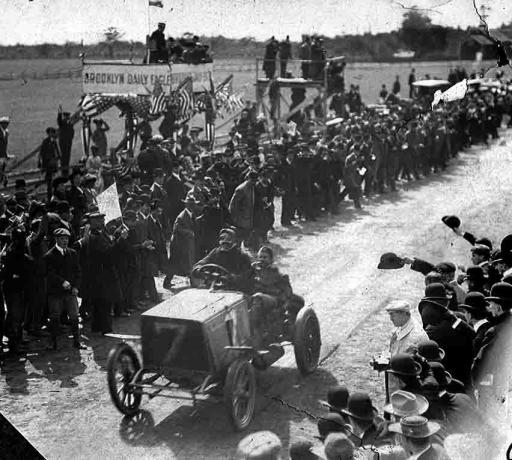
Panhard #7 (1904)
The first winner of the Vanderbilt Cup Races
Make: Panhard
Year: 1904
Mechanician: Eugene Lajunie
Horsepower: 90
Finish Place: 1
Average Speed: 52.2
The #7 Panhard driven by George Heath was one of three identical 90-HP Panhards entered in the first Vanderbilt Cup Race. Averaging 52.2 mph, the Panhard won the 1904 Vanderbilt Cup Race
Related Posts
-
May 27 2025
Friday Mystery Foto #31 Solved: An Antique Lithograph of the 1904 Vanderbilt Cup Race
Did you identify this antique lithograph?
-
Jul 15 2023
Future Vanderbilt Cup Race drivers in the landmark 1902 Paris to Vienna Race
Nine future drivers of the Vanderbilt Cup Races competed in the great 1902 Paris to Vienna Race.
-
May 13 2023
Greg O’s Garage: From the Peter Helck Collection- The Priest and “The Oldest of Them All”- An 1891 Panhard & Levassor
Photos with a great story from the Helck/Bradley photo box.
-
Mar 28 2022
Mystery Friday Foto #13 Solved: The 1904 Vanderbilt Cup Race winner #7 Panhard driven by George Heath stopped at a Control
Jeanne Booth, an archivist at the Hicksville Public Library, was seeking your assistance in identifying this Mystery Foto found in the library's collection.
-
Aug 11 2021
Greg O’s Garage; From the Helck Family Collection: The official 1904 Vanderbilt Cup race program
The complete 1904 race program
-
Sep 03 2016
Westbury Times: Grandstand Site Raced Into History
The location of the grandstand area for the 1904 and 1906 Vanderbilt Cup Races was recently designated by the Village of Westbury as one of six historic landmark sites. Reporter Leigh Anderson takes a "closer look" in this week's issue of Westbury Times.
-
Jul 27 2016
Translation: October 1904 La Stampa Sportiva: The Vanderbilt Cup
Professor Pau Medrano Bigas, Professor of Graphic Design at the University of Barcelona, has forwarded several articles on William K. Vanderbilt Jr. and the Vanderbilt Cup Races from the Italian magazine La Stampa Sportiva published from 1902 to 1910.
-
Jun 27 2016
Mystery Foto #26 Solved: A Unique View of the 1904 Vanderbilt Cup Race Grandstand
This weekend's Mystery Friday Foto was an image of a Vanderbilt Cup Race grandstand.
-
Sep 23 2014
Article: “1904 Vanderbilt Cup: Dark Horse- What Hope for the Pope-Toledo?”
Tony Kaye has forwarded this article concerning the 1904 Vanderbilt Cup Race and the #6 Pope-Toledo published in the November 1967 issue of Car Life.
-
May 31 2014
VanderbiltCupRaces.com Exclusive: Spectacular Photos of the 1904 Vanderbilt Cup Race
On Friday, October 7, 1904, the day before the first Vanderbilt Cup Race, 60 superintendents and engineers of the Association of Licensed Automobile Manufacturers (A.L.A.M.) gathered for a 65-mile "meet" covering Manhattan, Bronx and Westchester. On the next day, many of the participants ventured to Long Island to see the first Vanderbilt Cup Race. One A.L.A.M. member documented the 1904 Vanderbilt Cup Race..
-
May 10 2014
Video:“The Location of the Start/Finish Lines of the 1904 and 1906 Vanderbilt Cup Races”
The recent AmeriCarna "Vanderbilt Cup" episode focused on the six Vanderbilt Cup Races held on Long Island and the Vanderbilt Cup trophy.This two- minute segment features a trip to Jericho Turnpike in Westbury- the location for the Start/Finish Lines, grandstands and officials' stand/press box for the 1904 and 1906 Vanderbilt Cup Races.
-
Mar 19 2014
Henry Austin Clark Jr. 1974 Article: “The Vanderbilt Cup Races- Part I: 1904”
Tony Kaye has forwarded a September 1974 article by Henry Austin Clark Jr. on the Vanderbilt Cup Races describing many of the breakdowns and accidents. Here is the section on the 1904 race.
-
Feb 22 2014
Exclusive Firsthand Account of the 1904 Vanderbilt Cup Race: “A Very Successful Trip”
Walter Gosden has discovered an original October 11, 1904 letter from"Nephew Harvey Bell" to his "Uncle John" describing his adventures in a US Long Distance automobile to watch the 1904 Vanderbilt Cup Race.
-
Jul 20 2013
Then & Now: The Hempstead Control For the 1904 Vanderbilt Cup Race
Joe Oesterle: Do you know exactly where these old pictures (of the Hempstead Control) were taken?
-
Jul 16 2013
The Hempstead Control in the 1904 Vanderbilt Cup Race
The 1904 Vanderbilt Cup Race consisted of ten laps of the 30-mile course with controls in Hicksville and Hempstead.
-
Jul 06 2013
Then & Now: The Massapequa Turn for the 1904 Vanderbilt Cup Race
One of the most exciting locations to watch the first Vanderbilt Cup Race was the turn from Massapequa-Hicksville Road onto the new Bethpage-Hempstead Turnpike in present day Plainedge. Here's the "Then & Now."
-
Mar 09 2013
Nathan Lazarnick: The Pioneer of Automotive Photography
The most prolific photographer of early automobile racing and the Vanderbilt Cup Races was Russian emigrant Nathan Lazarnick. His profile and several of his unique photos are posted tonight.
-
Oct 08 2012
108th Anniversary of the 1904 Vanderbilt Cup Race
Monday marked the 108th anniversary of the first Vanderbilt Cup Race on October 8, 1904. In celebration of this historic race, here are the two-minute American Biograph film of the race and several of my favorite 1904 race images.
-
Aug 14 2012
CSI Challenge: How Many People Attended the 1904 Vanderbilt Cup Race?
The CSI (Cup Scene Investigation) Team of VanderbiltCupRaces.com has been asked to estimate the number of people who actually attended the six Vanderbilt Cup Races held on Long Island. First up, the 1904 Vanderbilt Cup Race held on a 30.24-mile triangular course in Nassau County and Queens.
-
Dec 13 2011
Profile: The #7 Panhard Racer- First Winner of the Vanderbilt Cup Races
The three 1904 Vanderbilt Cup Panhard racers were the elite of the 18 car field. The Panhards of winner George Heath and teammate George Teste led all but two of the race’s 10 laps. Albert Clement in another French car, the Clement-Bayard, led the other two laps.
-
Dec 12 2011
Starting Lineup: The 1904 Vanderbilt Cup Race
Eighteen racers participated in the first Vanderbilt Cup Race held on October 8, 1904. Photos of 17 of the 18 entrants at the Westbury starting line on Jericho Turnpike are shown here for the first time. The #10 Fiat arrived late at the starting line and began with a running start.
-
Sep 07 2011
Race Profile: The 1904 Vanderbilt Cup Race- The First International Road Race in the USA
The inaugural William K. Vanderbilt Jr. Cup Race in 1904 was the first major international road race in the United States. Although William K. Vanderbilt Jr. was only 26, he was heir to a transportation fortune and had figured prominently in auto racing for nearly 10 years since sponsoring auto races as a teenager.
-
Dec 10 2010
Images of the Six Vanderbilt Cup Race Finishes
Photos of the exciting finishes of the six Vanderbilt Cup Races held on Long Island:
-
Aug 01 2010
Archives: 1904 Vanderbilt Cup Race
Links to posts related to the 1904 Vanderbilt Cup Race (Updated: December 31, 2011):
-
Apr 29 2010
The Eight Winning Drivers of the Vanderbilt Cup Races (1904-1916)
Eight drivers won the 11 William K. Vanderbilt Jr. Cup Races held from 1904 to 1916. Three drivers, Harry Grant, Ralph DePalma and Dario Resta, were two-time winners.
-
Mar 30 2010
The Six Winners of the Vanderbilt Cup Races (1904-1910)
These are the six winners of the Vanderbilt Cup Races held on Long Island from 1904 to 1910:
-
Dec 14 2009
Driver Profile: George Heath- The First Vanderbilt Cup Race Winner
Born on Long Island, New York in 1862 George Heath became an American living in Paris during the 1890’s. Drawn by the lure of France’s blossoming automobile industry he soon secured a job at the Panhard & Levassor factory. He first appeared as a driver of one of the company’s race cars in 1898, finishing 13th in the grueling, 889-mile Paris to Amsterdam to Pau Race.
-
Dec 05 2009
Film “The 1904 Vanderbilt Cup Race Course”
The course for the first Vanderbilt Cup Race in 1904 covered 30.24 miles of public roads in the center of Long Island. This 10-minute film documents the course using some of my favorite photos and clips from the American Biograph & Mutoscope film of the race.
-
Mar 04 2008
Film “1904 Vanderbilt Cup Race”
Welcome to VanderbiltCupRaces.com! In one of the earliest sports films ever made, the 1904 Vanderbilt Cup Race action was captured by cameramen G.W. Bitzer and A.E. Weed of the American Mutoscope & Biograph Company in Westbury and Plainedge.