Friday Mystery Foto #31 Solved: An Antique Lithograph of the 1904 Vanderbilt Cup Race
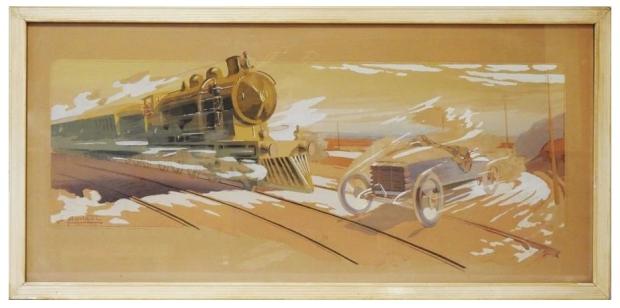
Did you identify this antique lithograph?
Identify;
- Which Vanderbilt Cup Race is depicted?
While the depiction is purely fictional, the image was to represent the 1904 Vanderbilt Cup Race.
- Identify the location
Due to the railroad crossing and relative higher population density, the 1904 race had a 3-minute control stop in Hicksville. At the 0.4 mile control, the cars were stopped, inspected, and allowed to proceed slowly over the railroad tracks led by officials on bicycles., so the idea that a race car attempted to beat out a train across the tracks is solely for dramatic purposes.
This lithograph depicted what was supposed to be the Hicksville LIRR crossing.
- race car and driver
The 1904 #2 DeDietrich driven by Fernand Gabriel with D. Miollans as his mechanician.
- Name of the artist of the original painting
The original 1907 illustration was done for a lithograph by Ernest Montaut (1878-1909) and/or his wife Marguerite Montaut.
Congrats to Steve Lucas and Art Kleiner for solving the lithograph mystery. Kudos to Art for the supporting documents.
Greg O.
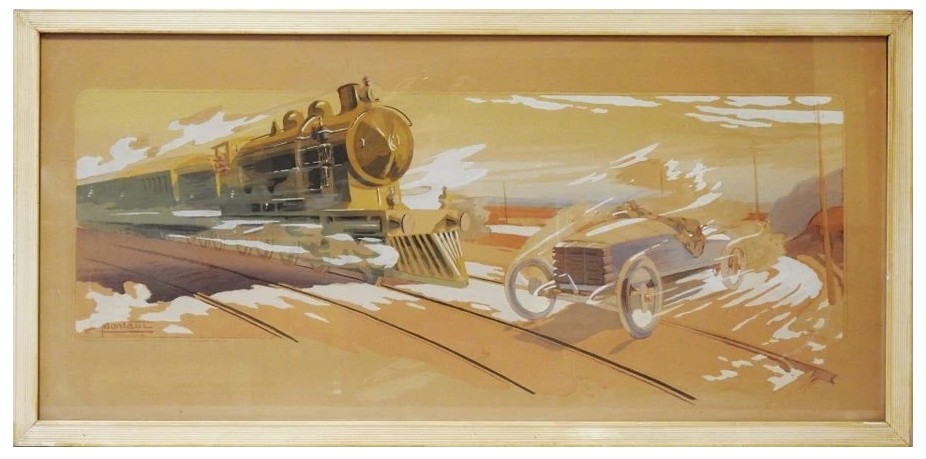
This same image was also utilized for a humidor Vanderbilia found at the Simeone Foundation Automotive Museum.
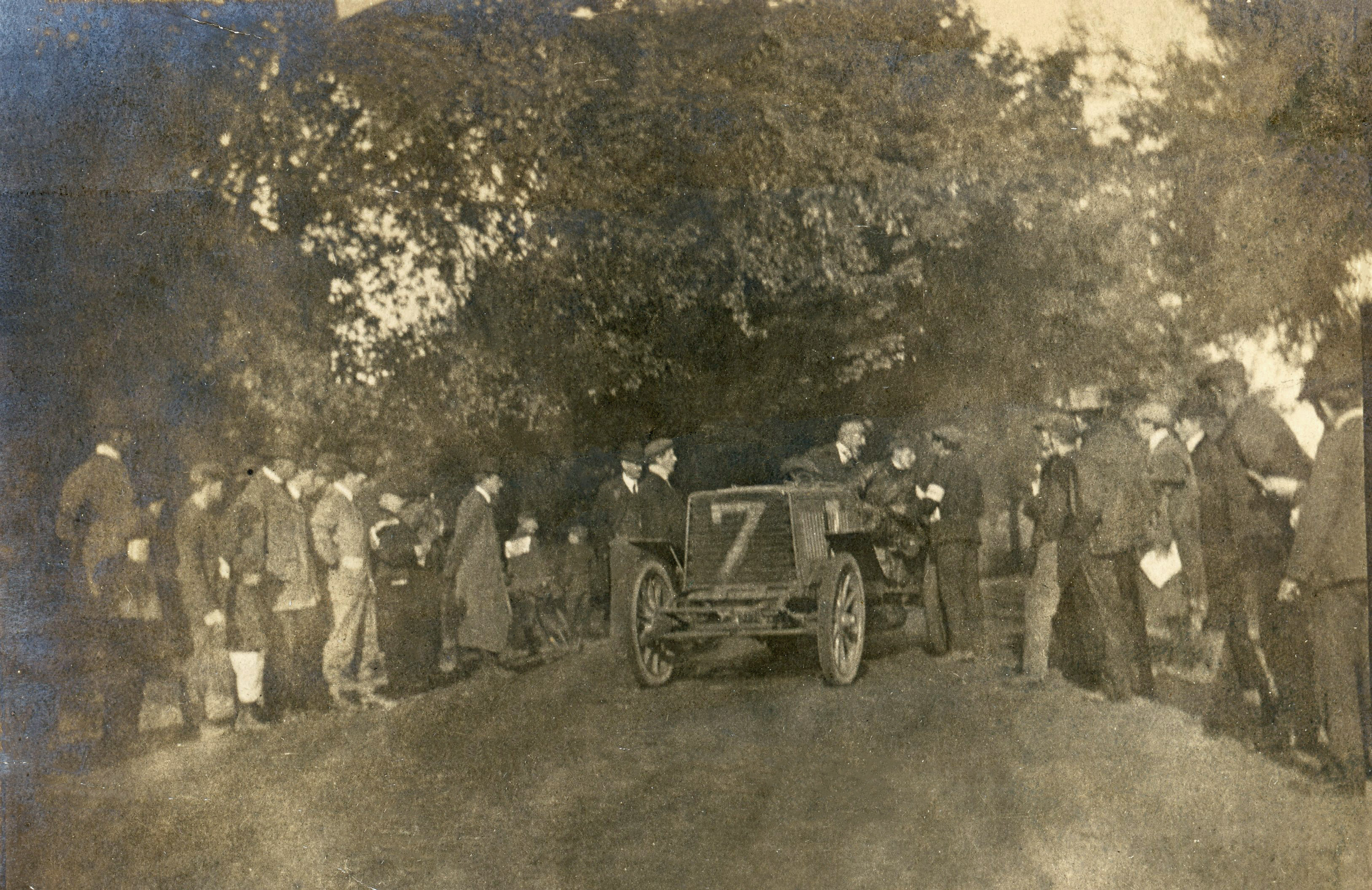
The 1904 Vanderbilt Cup Race winner #7 Panhard driven by George Heath stopped at the Hicksville Control.
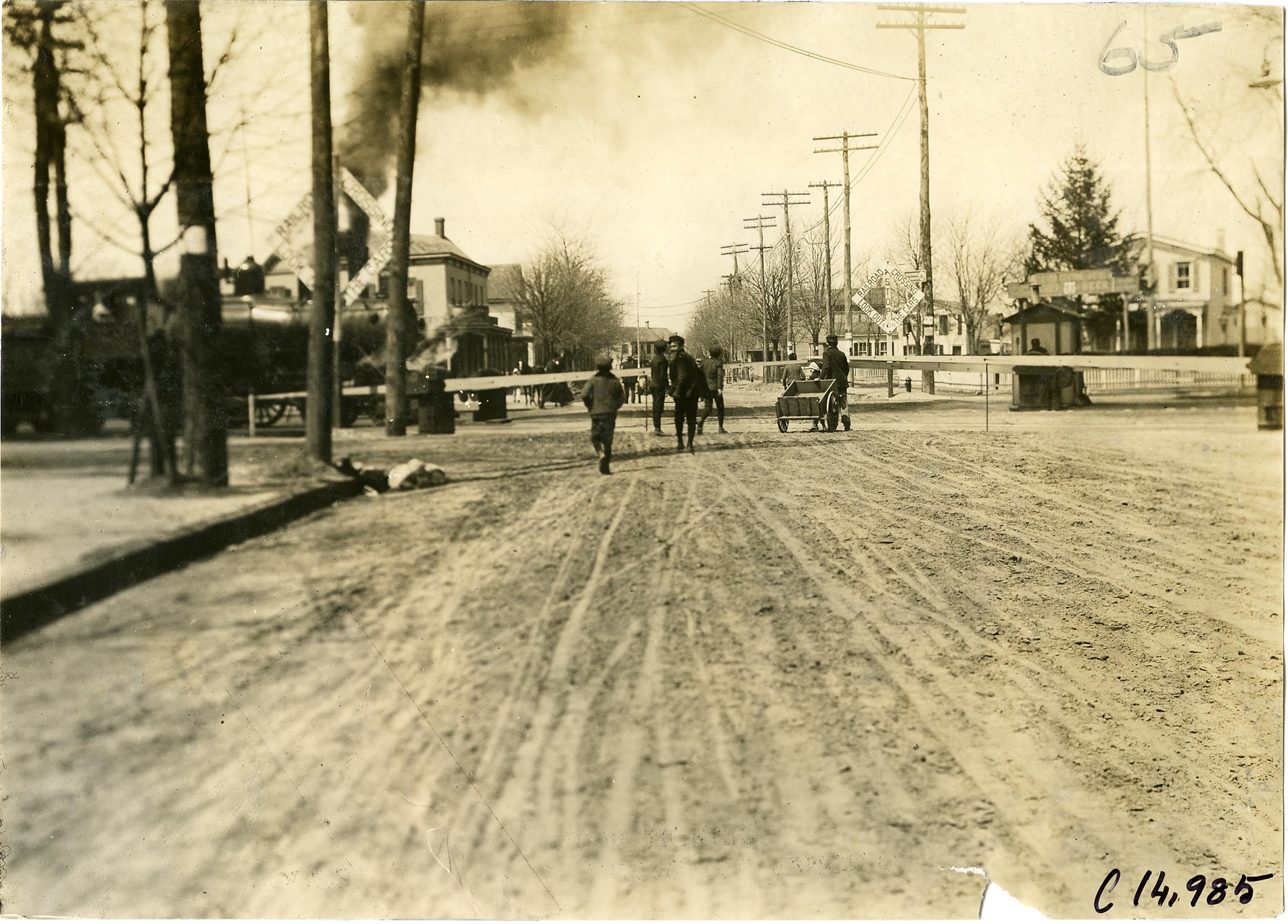
(1904): The railroad crossing on the 1904 course looking north on Broadway.
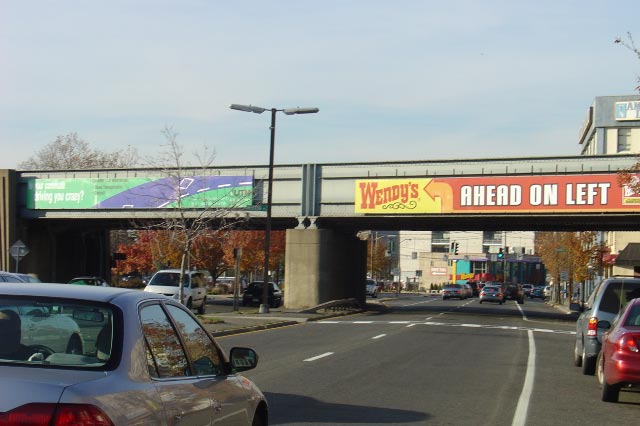
(2004): The same location as it looked 100 years later.




Comments
This is a print of an original painting by Ernest Montaut (some accounts credit his wife Marguerite) entitled “La Coupe Vanderbilt”. It depicts the #2 De Dietrich racer during the 1904 Vanderbilt Cup Race at the LIRR grade crossing on Broadway in Hicksville. The driver was Fernand Gabriel with D. Miollans as the mechanician.
1904
Hicksville
Loraine-Dietrich #2 driven by Fernand Gabriel
Ernest Montaut
My guess doesn’t add up but this could be the first documented automobile-railroad crossing accident in the US, which occurred on 30Oct1910, at the LIRR Post Ave crossing in Westbury, NY. French driver Henri Fournier and three passengers were thrown from the auto but all survived the collision. If memory serves, the touring car was heading north orienting this print to look SE. But the auto in the print looks like a racer
Gentlemen, regarding the 1904 fictional print and the length of the 3 minute control in Hicksville, the print has the racer heading north with a westbound train at the Jerusalem Ave crossing. The racer should’ve been heading south instead on the clockwise course, but it’s indeed fictional. The 3 minute control on the scale map below measures its length at 1/4 mile, 0.25 mile. Is there additional information regarding the 1904 race?
Does anyone have information about the August 3, 1913 grade crossing accident at Wreck Lead? Willie K. was in his automobile 5 minutes behind one belonging to his friend, S. Osgood Pell. Pell tried to make the crossing ahead of an electric train operated by my great-grandfather, George J. Easton; Pell’s auto was struck and he was killed as was his friend, William Laimbeer, along with the chauffeur, who was apparently not the driver. I’ve been researching this incident for years. I’m especially interested in the Pell’s auto, which in newspaper accounts was referred to as a limousine. I have yet to ascertain a make or model. Pell had a Paige registered in 1912. Accounts also describe there was a glass partition between the front seats and rear. I am also interested in which of Willie K’s automobiles Vanderbilt was driving. And Howard, if my book is ever published, might I be able to obtain the rights to the lithograph pictured above? It pretty much sums up what happened, except for the type of train engine. Thanks for any info, including stories of other such common grad-crossing collisions.