VanderbiltCupRaces.com Exclusive: “The 1913 Long Island Economy Run” by Walt Gosden
Historian Walt Gosden has written this exclusive article on a historic Long Island Race that has been lost in history...until now.
Enjoy,
Howard Kroplick
The 1913 Long Island Economy Run
by Walt Gosden
Article and photos © Walt Gosden
The early days of the automobile trying to prove itself worthy as an alternative to the centuries of horse drawn transportation saw many different “contests” or acts of durability. These were done to prove that a motorized vehicle with mechanical “horsepower”. was reliable and cost effective.
The Franklin air cooled car was a product of a company in Syracuse, N.Y. Franklin being air cooled with no radiator was one of the few car companies that did not use a radiator to keep the operating temperature of the motor cool. Franklin had many test drivers use their car for reliability runs across country and locally. It was an era before WWI when paved roads could be found in major cities but not necessarily so on roads once you were out of the city limits 50 miles or so.
Merrick Road on Long Island was one of the three or four west to east main roads that had been in use for many decades, first as trails for horses, then horse and wagons and eventually trolley cars to transport the population.
Franklin wanted to prove how well made and economical it was. Long Island was an ideal location: it was flat, a larger population (much activity to escape from the heat of Manhattan to Long Island communities by the seashore) and the publicity from a demonstration would be covered by the area newspapers. This was an era of printed material – no radios, television, Internet, or electronic communication. Long distance messages were still mainly done by telegraph operators.
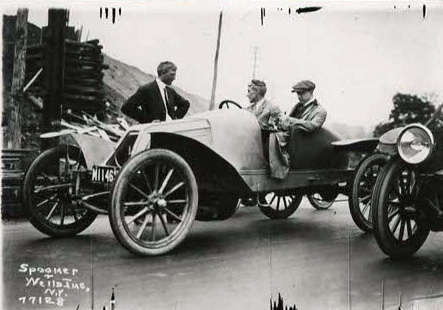
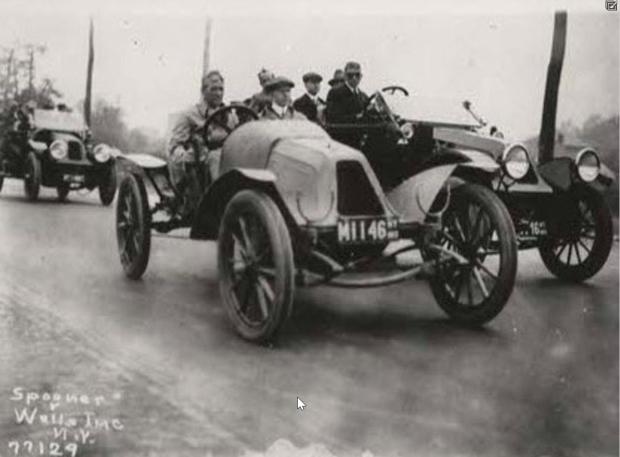
S.G. Averell was one of the major drivers for the Franklin Company to prove the worthiness of their cars. In 1911, a 4 cylinder 18 horsepower ‘speed car’ was constructed by the company. It had minimal body and fender equipment to cut down on weight. It was not their most powerful motor – that was a 6-cylinder car.
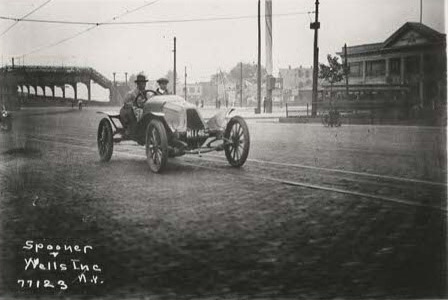
The start of the Economy Run was in Queens County and the route was on Merrick Road (which started at Merrick Blvd. in Queens). As can be seen in these period photographs taken by the Spooner & Wells Company of New York City, Merrick Road had a train track running on its southern edge right next to the road! The start of the race was in an area of more buildings and you can see a bridge in the rear of one photo on paved brick roads. The further east the road went it was still a great flat surface but not paved just coated in oil.
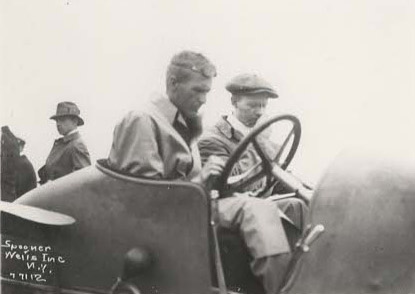
Averall is at the wheel with no hat on but did have goggles to off sent any dirt.
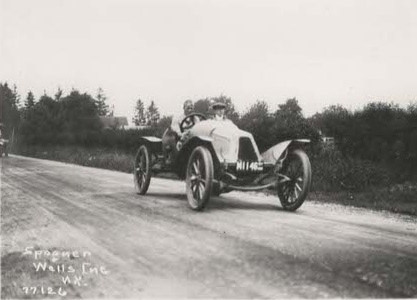
The run took place on June 2, 1913 and set a record for one gallon of gas driving 83.5 miles.
The 1911 Franklin Averell Special Speed Car Today
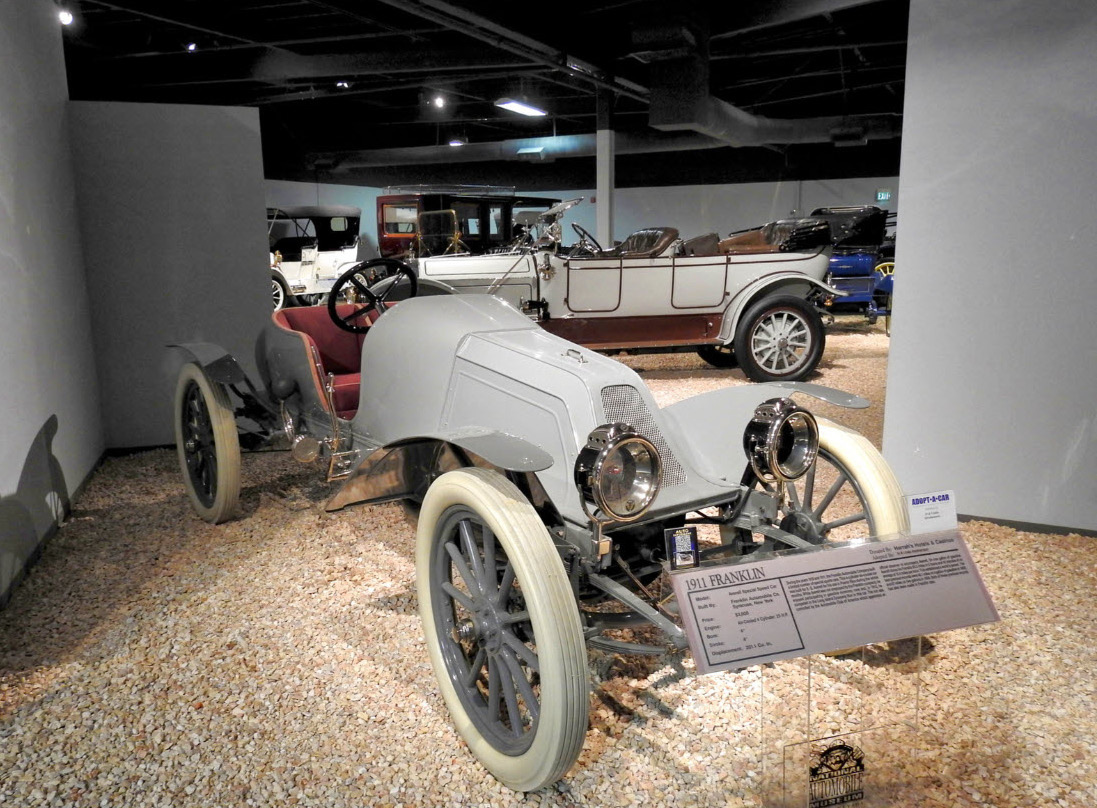
The car still exists today and was restored by Bill Harrah for his museum in Reno, Nevada.
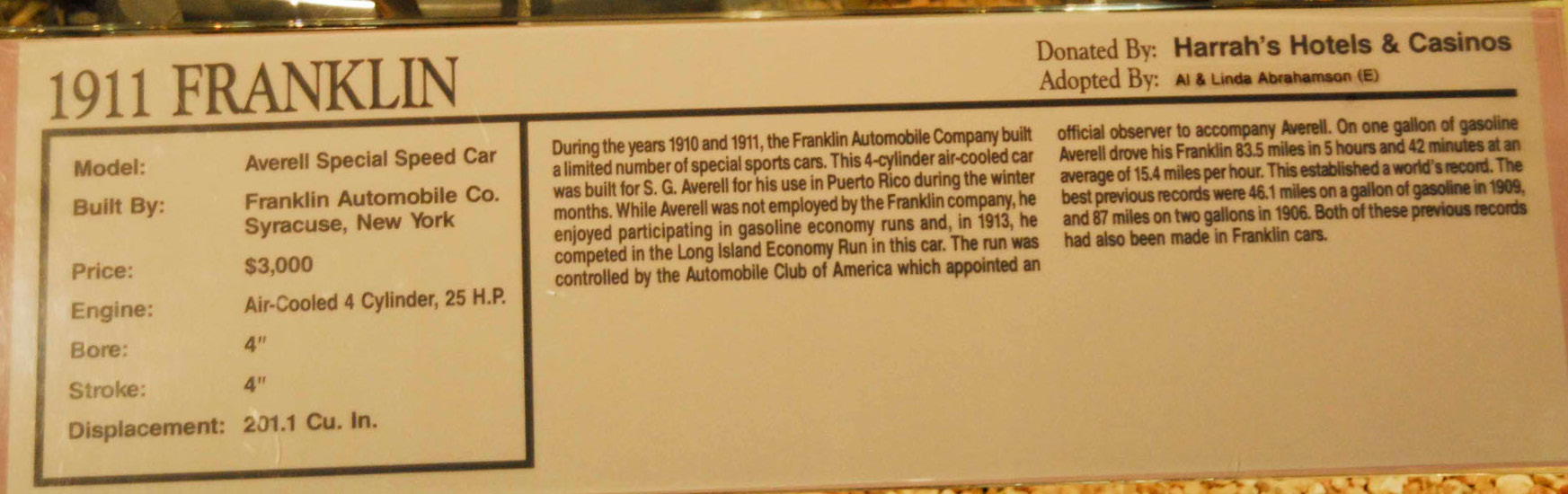
Bill was a good friend of mine, and we would spend a week together each summer in central NY State at an annual car show driving event for Franklin cars. He saw this car in an unrestored state at the Hershey, Pennsylvania. October Eastern Fall meet over four decades ago and bought the car. It had been in a “museum” of cars stored in a barn in Pennsylvania. Soon after purchase I wandered by his flea market spaces in the “Blue” field at Hershey. He grabbed my arm, and we walked/ran about a ½ mile west so he could show me his latest acquisition.
I was happy for him but panting from the quick trip to see it. As he was 6 foot 4 inches tall and I am 6 feet tall, he had a much greater ability to take larger steps to get someplace. He apologized when he saw me huffing and puffing but also chuckled like a little kid at his new old car/acquisition.
So there is a part of Long Island history that is not often considered that I thought I would share with you because I had the great period images and knew the car on a different level than most.


Comments
83.5 miles on a gallon of gas? Could this have been a bit of exaggeration or perhaps over promotion. Unless the vehicle was so light, the route so flat, no stops were made, etc.
Bob
Yes it was a very flat route and few curves, plus the oiled pounded flat surface made a very smooth road (kind of unheard of at the time) as you mention, no stops were made. This was the lightest car Franklin had on offer chassis wise - no radiator so much lighter weight. Their factory motto at the time was ” riding like gliding”. The car is basically 2 bucket seats on the chassis, even fenders were minimal and of aluminum.
Walt
Wonderful story Walt Thanks for sharing it We wonder if this car would have passed the CAFE requirements of today?
Informative piece of the Franklin during the 1913 Long Island Economy Run. Thank you Walt Gosden for rare historical content, and the challenge all autos were subjected to. The bridge photo appears to be Queens Plaza in LIC, with cobblestone streets I remember in the ‘70’s at the foot of the Queensboro Bridge. A few 1909 images below
This was a “race” between multiple marks and was judged by 3rd parties. Each car was given a carefully measured single gallon of gas and then the gas cap was sealed. So no, Franklin did not exaggerate.
Today, this car would be called an “ultra-light.” H.H. Franklin invented die-casting of aluminum and even came up with the word. Most Franklin cars had aluminum body parts, engine block, pistons and other pieces. For a time, Franklin was the #1 consumer of aluminum in the world.
13 years after this test another inventor built the first Ford Trimotor airplane. It was the first all metal plane built in the USA and of course he used an aluminum alloy: duraluminum. He was William Bushnell Stout and his motto was: “Simplicate and Add More Lightness.”