An Al Velocci Special: The Garden City Headquarters of the Long Island Motor Parkway
Motor Parkway guru and master historian Al Velocci recounts the history of the Motor Parkway headquarters.
Greg O.
THE GARDEN CITY HEADQUARTERS OF THE LONG ISLAND MOTOR PARKWAY
by AL VELOCCI
Recently, the Long Island Motor Parkway has come to the forefront in Garden City with the construction work performed on the Motor Parkway Garden City Toll Lodge building, now located on East Seventh Street in downtown Garden City.
While the Toll Lodge and its history are familiar with many, it is not generally known that the headquarters of the Long Island Motor Parkway for most of its existence was also located in Garden City.
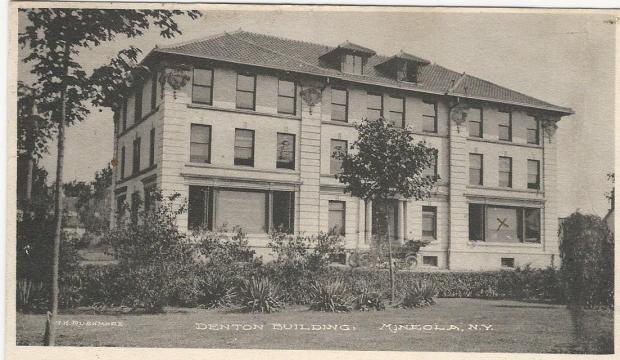
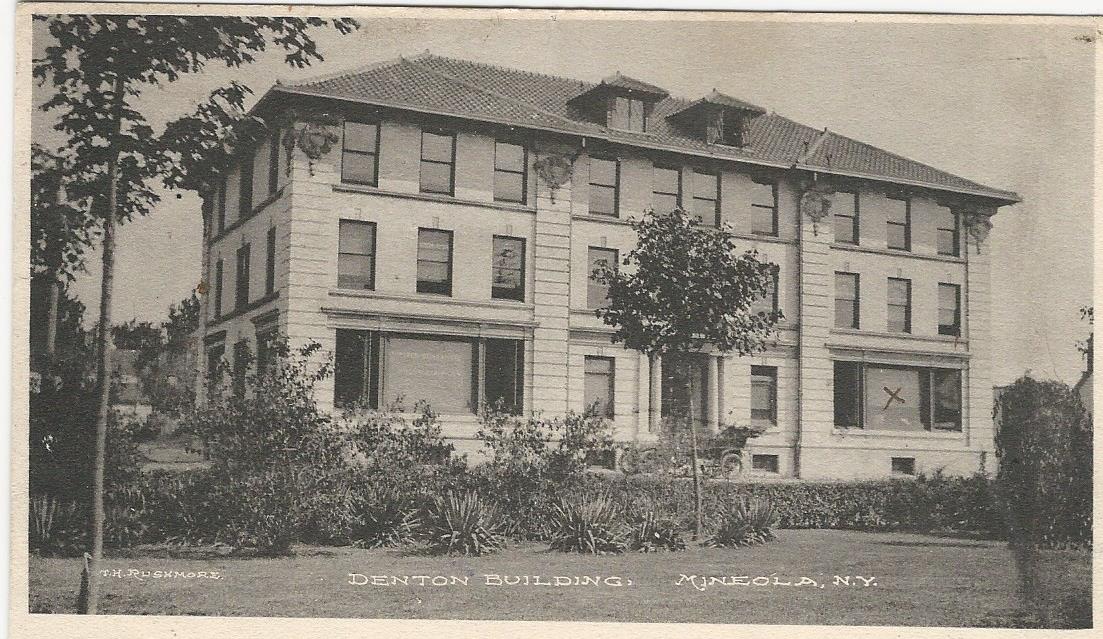
The Motor Parkway opened its first office in 1907 in Mineola in the still-standing Denton Building located on the northwest corner of Old Country Road and Franklin Avenue.
Photo; The first offices in the Denton Building, Garden City, 1909. The 'X' marks the office windows
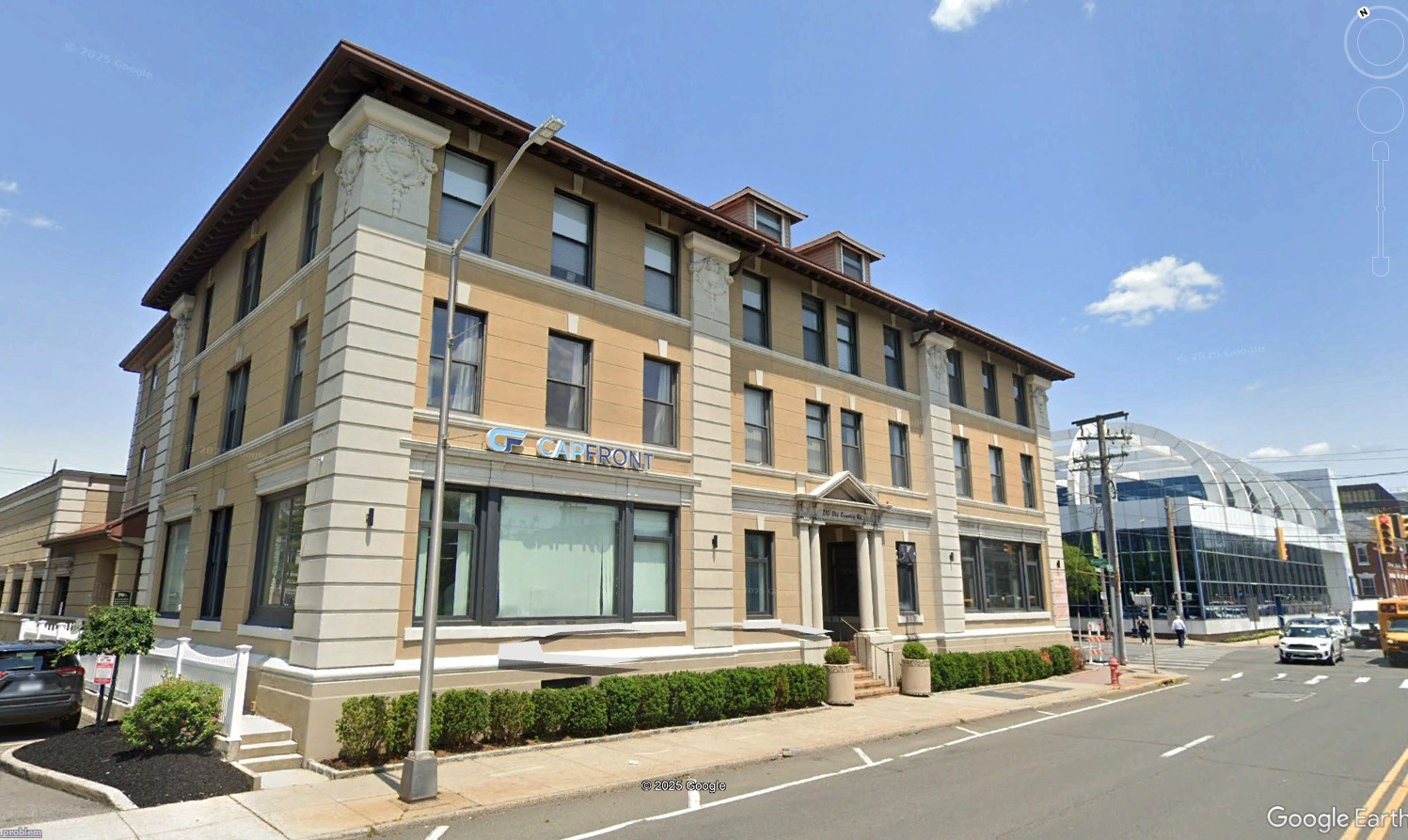
Photo; the Denton Building as seen in June 2025.
In 1912, the Parkway’s President, William K. Vanderbilt Jr., decided to move the Parkway office to today’s Vanderbilt Court off Clinton Road in Garden City. The office staff consisted of A.J. Kienzle the Parkway’s manager, and his secretary, Mary Wills.
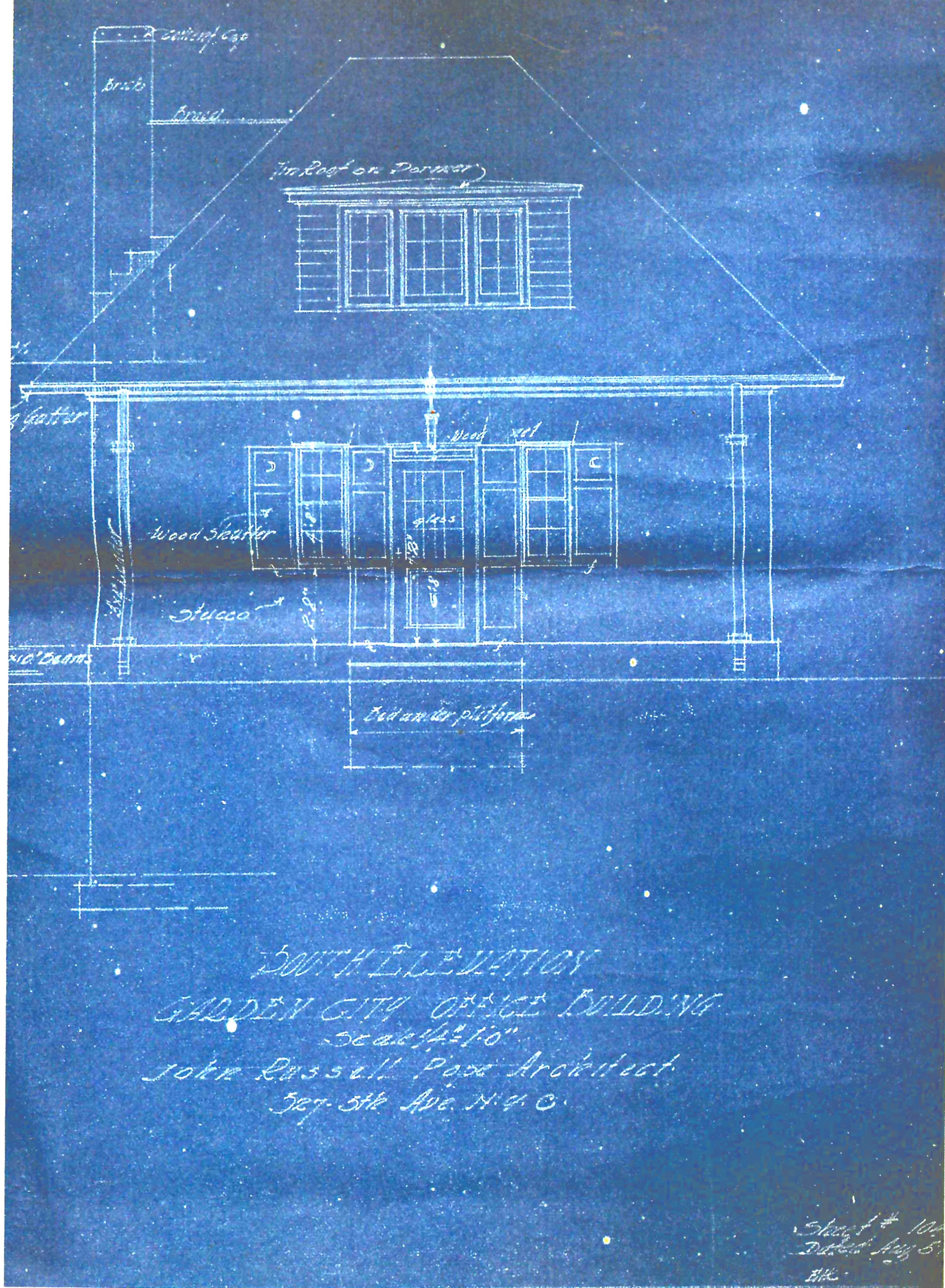
Vanderbilt commissioned John Russell Pope, who had designed the first six toll lodges of the Parkway, to draw up plans for the Parkway’s new office building.
Pope did so and the project moved forward to the point that bids were received for its construction.
It was at this point that Vanderbilt inexplicably changed his mind about moving the Parkway’s office from Mineola to Garden City.
Why it didn’t come about is lost forever in the minutiae of Parkway history. Pure speculation on my part, the reason for not pursuing the construction of the office building in 1912 was because the Parkway at the time did not own the land on which the building was to be constructed.
The property in question was obtained from the Garden City Company at no cost to the Parkway. The gift did come with conditions. One, it mandated an entrance from Clinton Road to the Parkway and two, the Parkway was required to build a Toll Lodge on the site. Both conditions were to be in place for a period of not less than ten years. It wasn’t until 1921 the Parkway took title to the site.
Photo; The first offices in the Denton Building, Garden City, 1909. The 'X' marks the office windows
Since moving the office to Garden City was not a pressing issue in 1912, the project was put on the back burner.
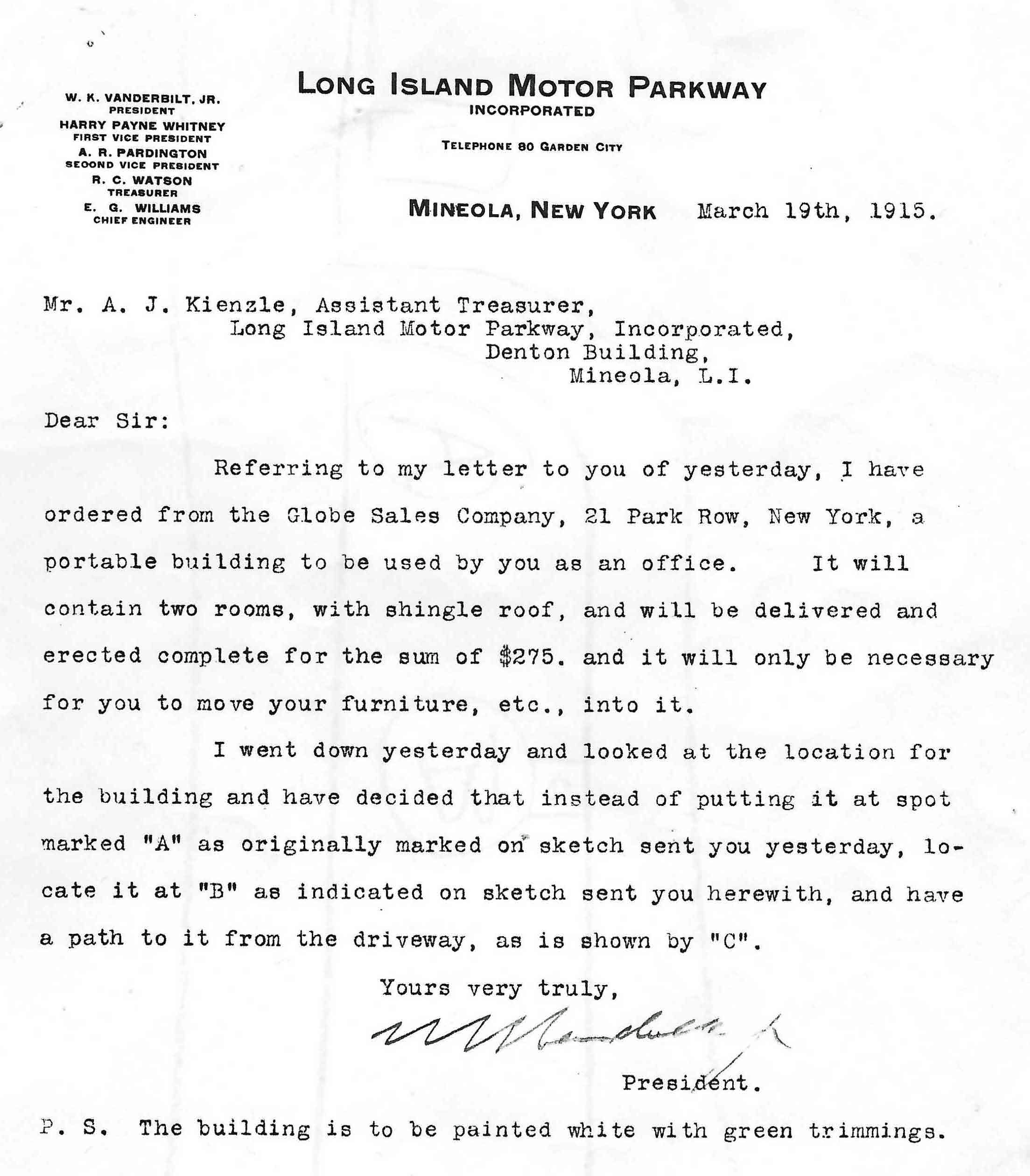
Vanderbilt, more accustomed to the landlords roll and weary of paying rent, came up with a solution to his conundrum in 1915. On March 18th that year, he wrote the Parkway General Manager A.J. Kienzle, instructing him to notify the owners of the Denton Office Building the Parkway will be vacating the premises on April 30, 1915.
Much to the relief of Kienzle, Vanderbilt decided to personally take charge of creating the new office space at Garden City. Kienzle, however, was concerned about Vanderbilt being able to accomplish this in less than six weeks.
Vanderbilt’s solution to the problem of not owning the land was to acquire a portable building for the office and one at minimal cost. On the next day, March 19th, Vanderbilt once again wrote Kienzle informing him a two room bungolow (sic) from the Globe Sales Company of New York City is “to be used by you as an office”. The structure was 12’ by 16’ in size and acquired at a cost of $275.00, which included not only delivery but also installation. Vanderbilt handled the entire transaction for the new office and personally selected the specific site where it was to be located. Then, adopting the role of decorator, selected the paint scheme for the office, specifying it was to be painted white, both in and out and with green trim.
Vanderbilt concluded the letter by informing Kienzle “All he had to do was move the furniture, etcetera, into it.”
Yea, right. Kienzle could not have been thrilled by the new quarters. Here he was, being ordered out of the most modern office building in Nassau County and told to operate out of what was basically a modified petitioned garage with windows and a walk-in door. Not only that, where the Denton Building had indoor plumbing, electricity, and central heat, his new digs would have none of these amenities. In his new surroundings, illumination would be by kerosene lamps, heat by a coal burning pot belly stove. Toilet facilities consisted of an outdoor privy. Well, at least it was hidden by a latticed enclosure.
Photo: The original letter Willie K. Jr. sent to Kienzle on March 19, 1915
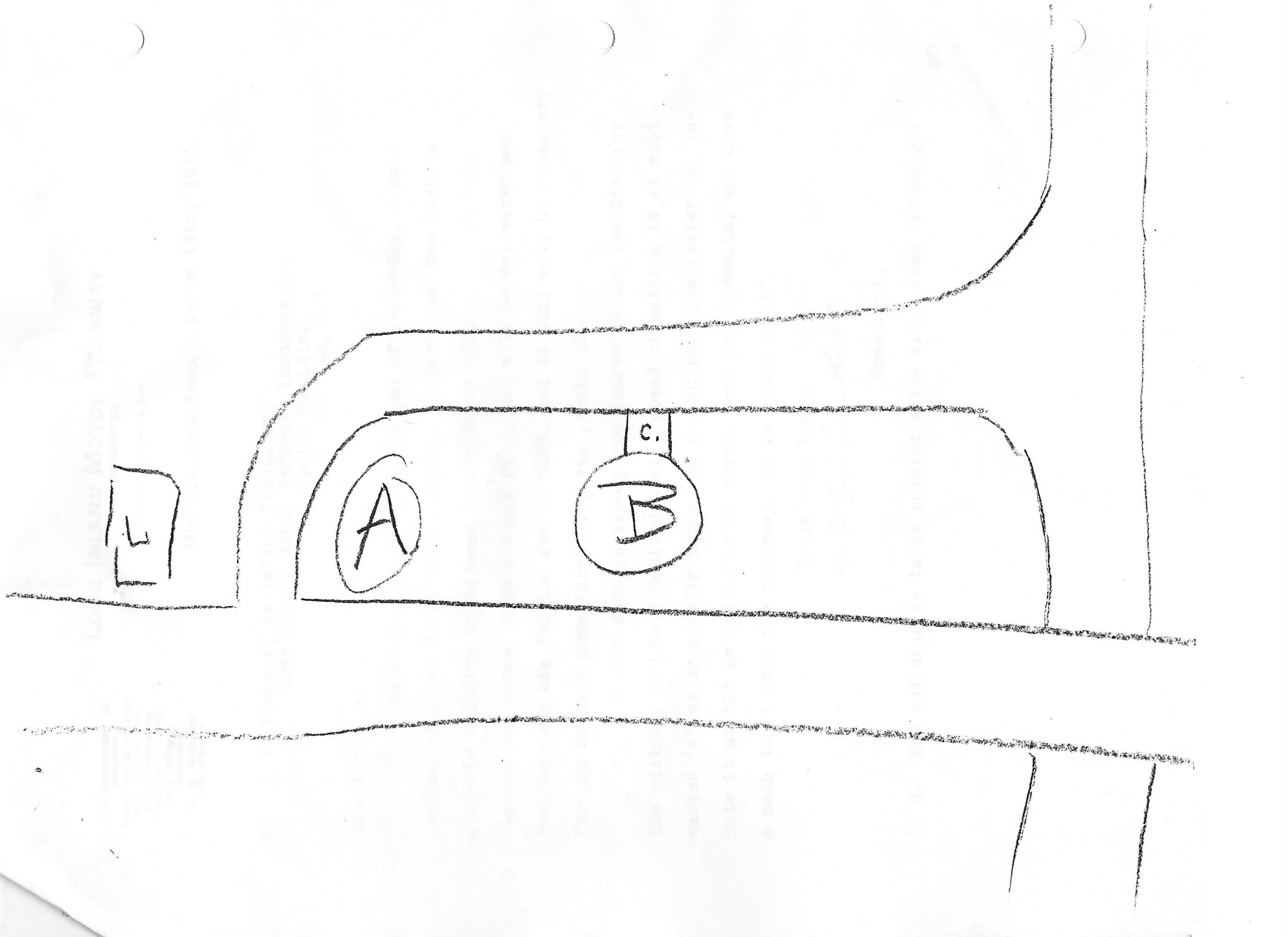
Photo; As described in the Kienzle letter above, here is Willie K's hand-drawn diagram of the property layout. Who knew Willie K was an artist?
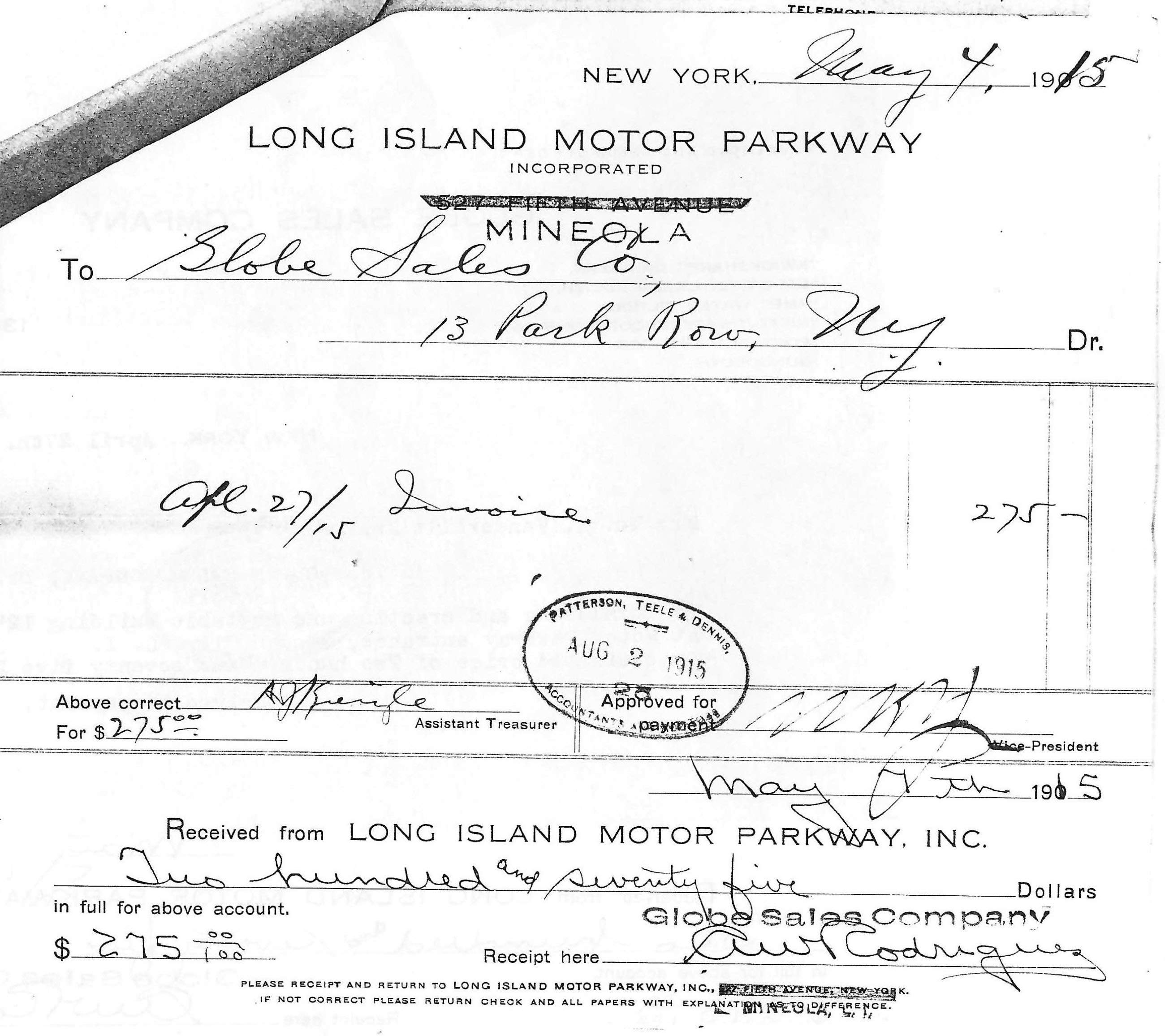
Photo; The $275 May 7, 1915 receipt from Globe Sales Co. for the new building at the Garden City site.
Adding to his annoyance about the move of the Parkway’s office to Garden City, was, at the time, Kienzle was living on Main Street in Mineola, about four short blocks from the Denton Building. An easy walk on most days since he most likely went home every day to have his lunch.
Kienzle was certainly entitled to his nickel’s worth at the complaint window.
Photo; The Pope plans for the G.C. office building which never was to be built.
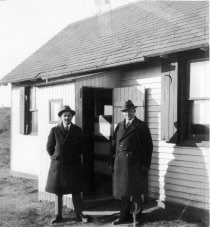
Because of an unusually rainy spring that year, the Globe Sales Company could not complete the assembly of the new office building by April 30th as promised. It would take an additional two weeks before the building was ready for occupancy. On May 15, 1915, Kienzle and his secretary, Mary Wills, reluctantly moved into their new quarters.
It wasn’t long before the 192 square foot bungalow proved to be too small. In August that same year, Edmond A. Lien, a Mineola Builder, added a ten-foot extension to the building, which set the Parkway back $187.
Kienzle would run the Parkways operation out of this building for the next fifteen years. In the early 1920s, as the Parkway’s fortune improved, the office was once again enlarged. The latest addition increased the size of the office to 27’ by 30’, part of which was used for the installation of two bathrooms. It was at this time, a ductless furnace replaced the pot belly stove and the building was wired, bringing the office into the twentieth century.
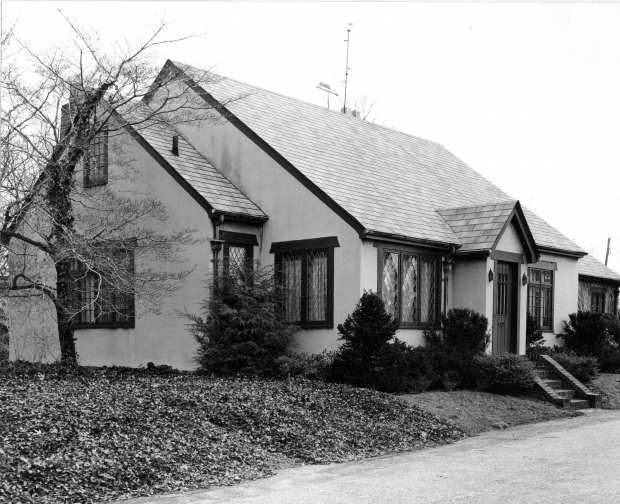
As 1928 was coming to a close, it was obvious the Parkway would have its best year ever. By this time, the office had become woefully inadequate. Even Vanderbilt conceded it had outlived its usefulness. Kienzle was able to convince Vanderbilt to replace the antiquated, by this time shabby-looking bungalow-office with a structure that would reflect the improved success of the Parkway. What was constructed is the building that still exists today on the north side of Vanderbilt Court, set up against the Parkway’s old right of way.
Rumor had it that John Russell Pope designed the new office building. He did not and the Parkway did not hire an architect to do so. Instead, architectural drawings were purchased and modified to suit the Parkway’s needs
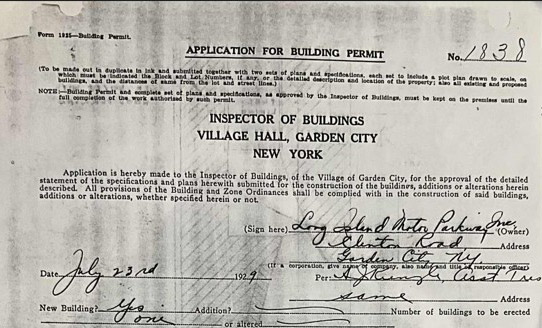
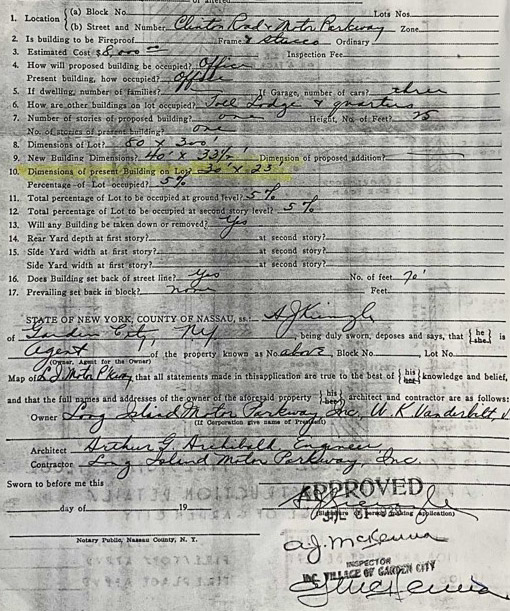
The modifications were made by the Chief Engineer of the Parkway at the time, Arthur G. Archibald, a Hempstead-based civil engineer and licensed architect.
On July 23, 1929, the Parkway was issued a building permit by the Village of Garden City. A. J. McKenna was the Village building inspector at the time and it was he that signed off on the application for the 40’ by 33 ½’ building. Before construction could proceed, the Parkway first had to appear before the Village Board of Zoning and Appeals. The original office building erected in 1915 was in use before that part of the Hempstead Plains was incorporated into the Village of Garden City. The area, in 1929, was now zoned for residential use. The office use of the building, therefore, was non-conforming, hence the need to appear before the Zoning and Appeals Board. The board quickly approved the application on July 30th, most likely due to the Parkway’s grandfathered status.
On August 2nd, the Parkway was issued building permit #1838 which allowed for “a one-story office building on the parcel of land situated on the east side of Clinton Road and south side of Parkway in Garden City East.” While the design of the structure does not mimic the Garden City Toll Lodge, it does share an architectural sympathy, and it was a vast improvement over the building it replaced. It could easily and comfortably fit into any part of the Village, its style not out of character with what was being built at the time.
The building was erected on the west side of the old office. The permit was issued with one covenant, which required the present one-story structure now situated on the lot shall be taken down or removed immediately upon completion of the new building. It was in fact not demolished but moved to an unidentified site; we can assume to a not-too-distant location. Perhaps it still survives to this day.
There was some speculation at the time that the new headquarters would also serve as Vanderbilt’s summer office. While a frequent visitor, Vanderbilt never sat at a desk at this location.
Photo; Application #1838 dated July 23, 1929. The approval for this application was received August 2nd. Note the estimated cost of the structure at $8000.00
With this major commitment to the area, Kienzle moved from Mineola to Garden City, taking up residence at 328 Seventh Street.
The new office building was built just prior to the start of what would become the Great Depression. I’m convinced that it would have been built anyway as many thought the Depression would end shortly and prosperity would return. As we know, the good times did not return and, like many other businesses, the Parkway suffered heavy losses as motorists opted to use local free streets and highways instead of paying to use the Motor Parkway.
Compounding the problem, was the free and more modern Parkways being built by Robert Moses at the time.
Every year thereafter, less motorists were using the Motor Parkway. Vanderbilt lowered fees, suspended maintenance, and reduced toll collectors’ salaries, all to no avail.
On Easter Sunday in April 1938, the Long Island Motor Parkway closed for good.
All the Parkway employees were laid off, except the general manager, A.J. Kienzle. Vanderbilt needed him for closing down the Parkway’s operation and disposing of the Parkway’s assets. It was at this time that Kienzle moved to 111 Seventh Street in Garden City.
One of the properties being sold was the Parkway’s office building. It wasn’t sold until 18 months later, on October 3,1939, to D.E. & M.B. Whitten, along with a quarter acre of land for $4,500.00.
In all likelihood, it would have sold sooner and at a higher price if it wasn’t for the fact the building lost its commercial zone use with the closing of the Parkway and now it could only be used as a residence.
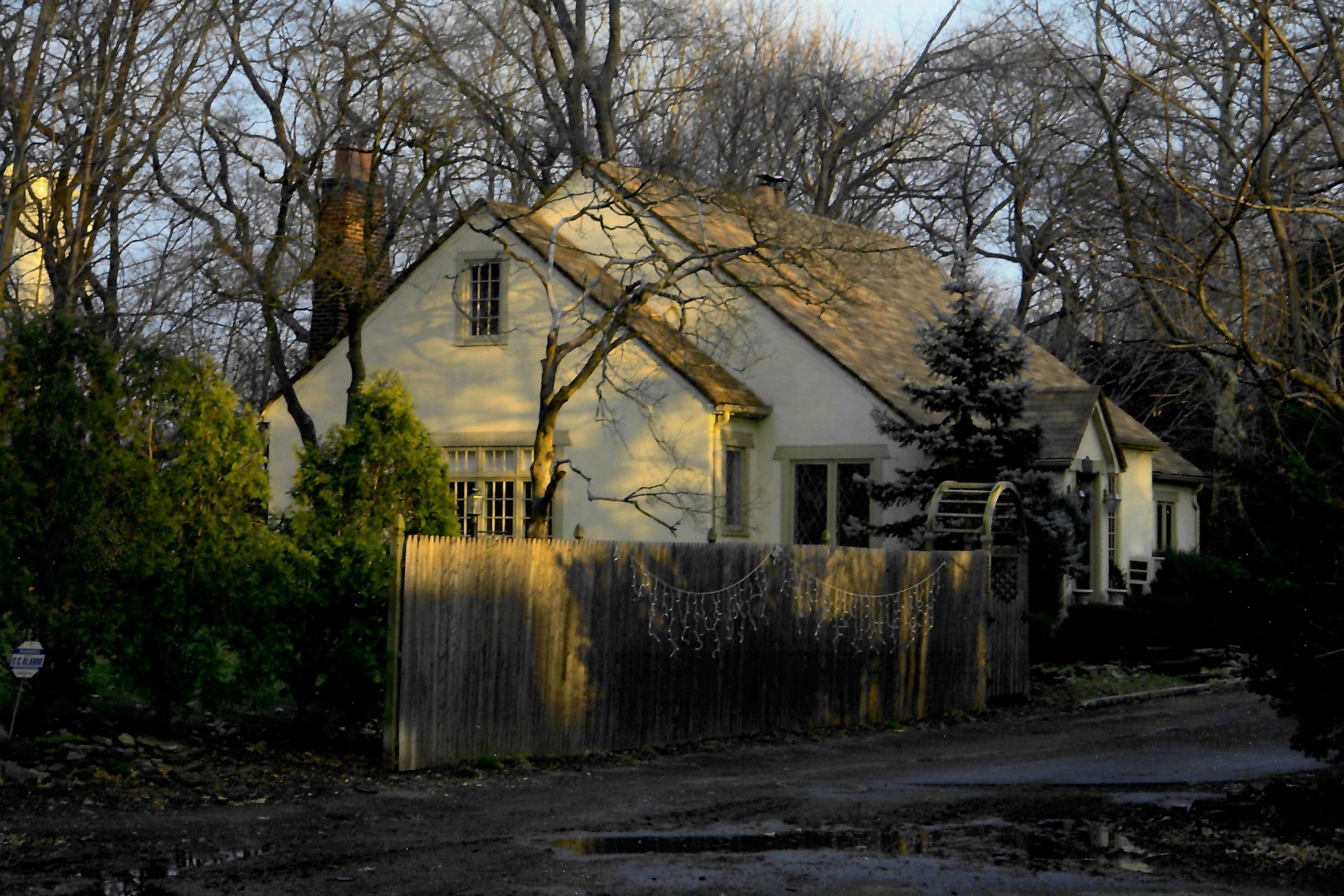
Photo; The final building on the site, still existing today as a private home.


Comments
Love every word of this incredible history dive. As a child this area of the Motor Parkway was a favorite for my son Gram and he always loved the house which still stands. He used to note that it would be great if we could live there. I agree!
Hello Al, Great story. Loved reading about all the historical details of that site. With regard to the original building, you speculate that it may have been moved somewhere locally. I seem to remember visiting a structure there back in the mid 1980’s that I thought was a garage. It was about 75 feet southeast of the lodge and open on the west side like a garage. Any thoughts?
Mr. V Intersting stuff. Bob A
Hi Steve, Glad you enjoyed the article. Regarding the fate of the old office building, a Webster Pearsall Jr. was paid $100.00 to move the building. The dollar amount suggests that he didn’t move it very far. The entire area to the southeast was and is very commercial/industrial so what you say makes a lot of sense.
Hi Al
Great story
$100 seems very little
Willy K and the LIMP sold the Massapequa toll lodge to Thomas and Josephine Zinzi
in 1938 for $100, probably because they lived there as employees of the parkway.
Thanks for the history, Al. Here’s two articles mentioning the HQ in the Denton Building. First is from January, 1907 and the second is a piece written by Arthur Pardington in September, 1910.