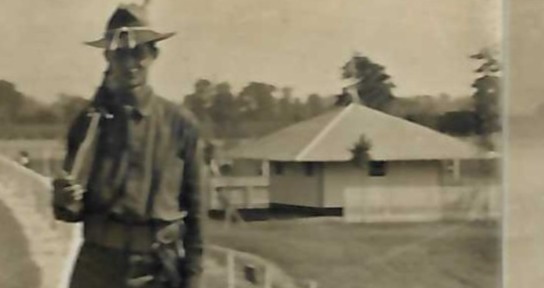
Mystery Friday Foto #34 Solved : A Guard on the Indianapolis Speedway Track in August 1909
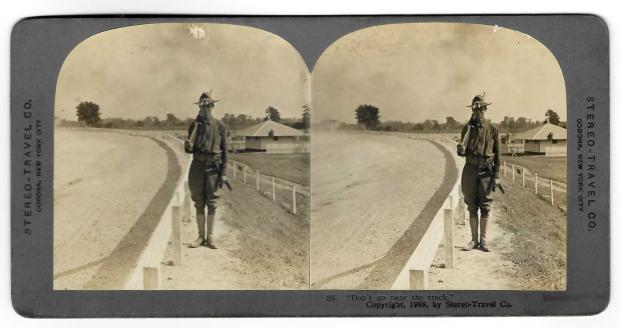
Did you identify this stereoscopic image?
This recently purchased stereoscopic image was bought under the pretense that it was a photograph of the 1908 Vanderbilt Cup Race, (as per the hand-written caption on the back of the photo) with the possibly of an Irish Guard volunteer posed in the foreground.( Volunteer Irish Guards were utilized for security in some Vanderbilt Cup Races)
However, after close examination and the initial submitted Comments, it is not a Vanderbilt Cup Race photo. In fact, we are certain this photo was not even taken on Long Island. We now know where and when this image was taken.
Answers to the Mystery Foto questions:
- Which track was being photographed?
The Indianapolis Speedway
- Which races were being held?
Documented the first races held at the Indianapolis Speedway held from August 19-21, 1909.
- What was a Stereo-Travel card?
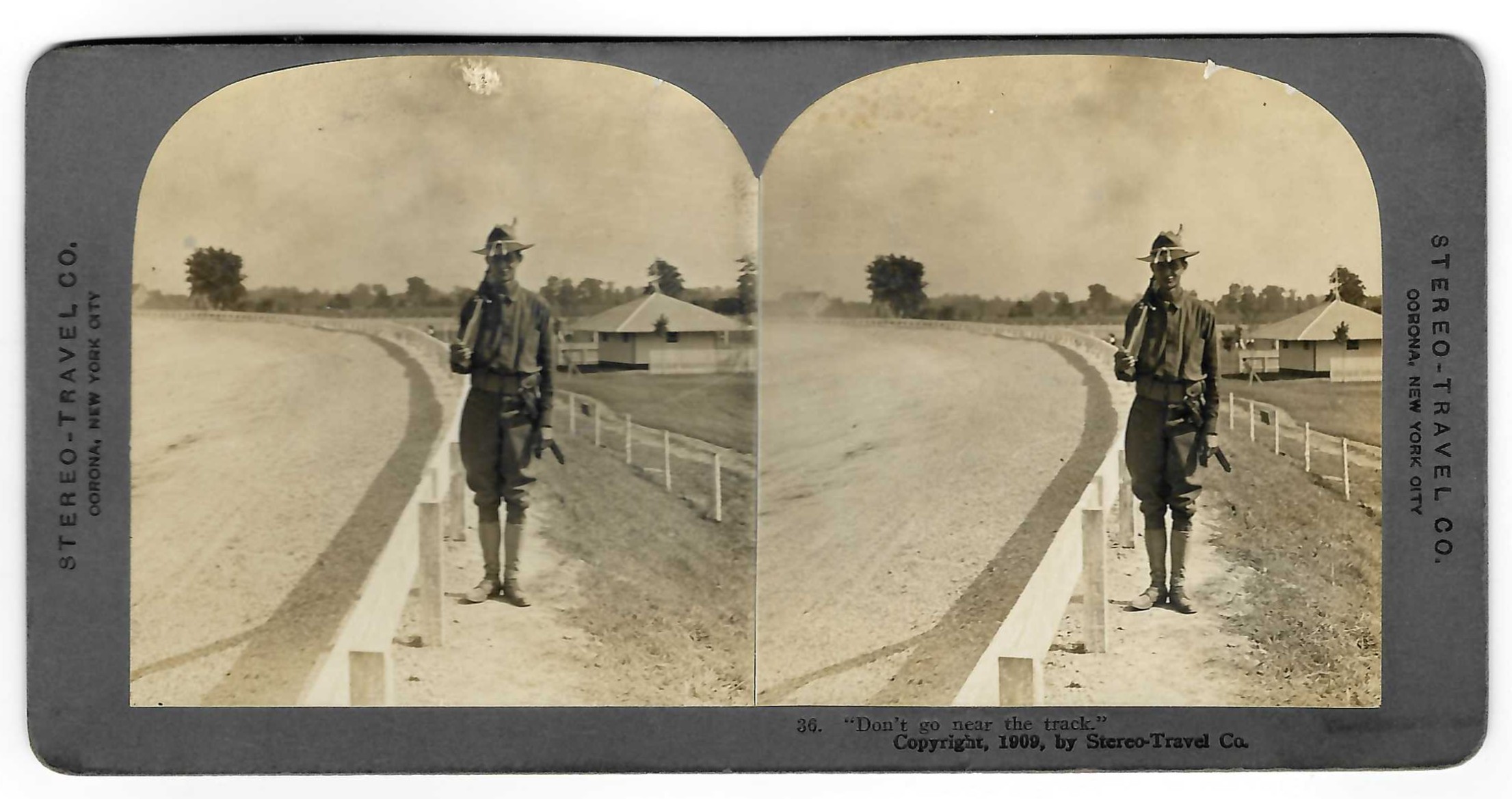
These cards were made by the Stereo Travel Company of Corona, New York. The stereoviews provided a 3D effect. Our Mystery Foto was part of a rare-40 card stereo set documenting the first races on the Indy Speedway.
Jeremy Rowe has documented the 40-card set in his vintagephoto.com website which is reposted below. Jeremy has also provided four other cards from the 40- card set. Thanks Jeremy!
Comments (7)
Congrats to Art Kleiner, Ariejan Bos, Kenneth Parrotte, and Steve Lucas for correctly identifying the Indianapolis Speedway track in August 1909.
Kudos to Jeremy Rowe for providing details on the 40-card set, the 1909 races and images of four additional cards.
Enjoy,
Howard Kroplick and Greg O.
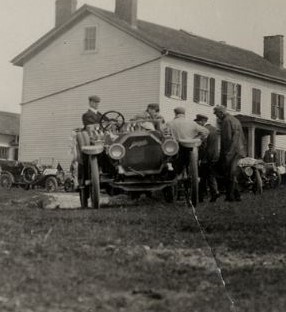
Closeups
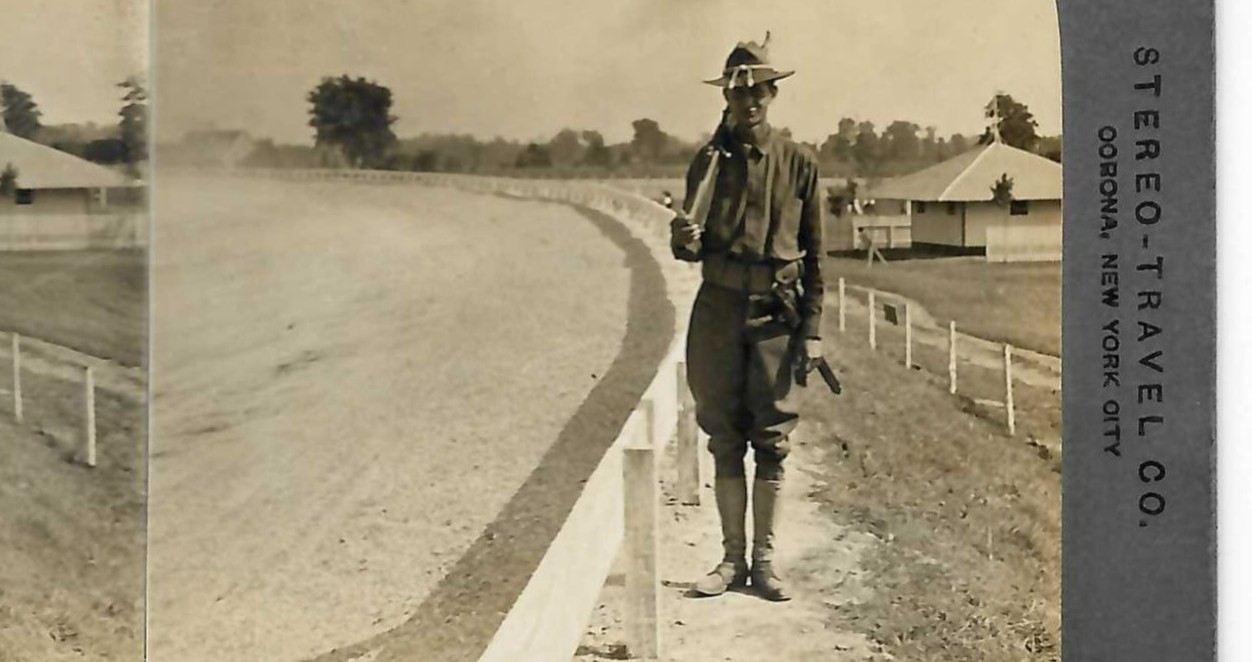
#36. "Don't go near the track."
Copyright, 1909, by Stereo-Travel Co.
Annotated Title List - 40-card Stereo Travel set - August 19-21, 1909 Indianapolis Race (Annotations in parenthesis) Copy and images courtesy of Jeremy Rowe.
This rare 40-card stereo set documents the first races held at the Indianapolis Speedway August 19-21, 1909. The rectangular 2 ½ mile racetrack was built at an estimated cost of $650,000 by a group of local businessmen on 328 acres about 5 miles northwest of Indianapolis, Indiana. The track included two long and two short straightaways and was initially paved with a mixture of crushed rock and tar. After the races, issues with the surface led to resurfacing the track with over 3 million paving bricks, and the track became the famous “Brickyard” a few months later – in December 1909.
Several races were held on the 2½ mile course August 19-21 to help promote automobile manufacturing businesses in Indiana. The race drew top drivers from across the country, some like Barnie Oldfield and Louis Chevrolet are still famous, others including Bob Burman, Jap Clemens, Ralph De Palma, Tobin DeHymel, Ray Harroun, Eddie Hearne, Tom Kincaid, Charlie Merz, and Lewis Strang are remembered only by racing aficionados.
Pioneer automobile manufacturers flocked to the event to compete for international coverage. Like the drivers a few companies like Buick, Fiat and Mercedes Benz are still familiar. Other marques attending the event like Apperson, Jackson, Marmon, Marion, National, Stoddard-Dayton, and Stearns disappeared long ago.
The first day program included two 5-mile, two10-mile races, and the 250 mile Prest-O-Lite Trophy Race. The second day included one 5-mile, two 10-mile and one 50-mile and several kilometer and mile record time trials. The final day schedule included a 5-mile, 10-mile, 15-mile, and 25 mile races. The culminating event was the 300-mile race for the 8 ½ foot tall $10,000 silver Wheeler-Schebler Trophy – claimed to be the most valuable ever offered for an automobile race and equal to the prize claimed by Glenn Curtiss for his 2 ½ hour flight from Albany to New York City in May 1910.
There were two fatalities during Thursday’s races. Driver Wilfred Borque and his mechanic Harry Holcomb were racing Knox No. 3. As Bourque was battling for the lead in the 250 mile Prest-O-Lite Trophy Race, the wheel slipped as he came through turn 4 on lap 58. The Knox swerved, hit a rut, and flipped over into a ditch. Holcomb was thrown into a post and was killed instantly. Bourque was trapped under the car and sadly also passed away. Borque was engaged to Miss Alexandria Boivin of West Springfield Massachusetts. The couple had been planning to marry on September 14. Ironically, Borque had promised his fiancée that he would give up racing after competing in the Vanderbilt cup race that fall.
The events generated huge crowds and adoring local press coverage. Each day’s racing results and records were noted, along with glowing stories about the potential for future events. Unfortunately, the “main event,’ the final Wheeler-Schebler Trophy race, was called to a halt after only 235 miles of the advertised 300 miles. As a result, the sponsor decided not to award the $10,000 silver trophy. The August 23, 1909 Indianapolis News note that:
“ …there was much regret over the enforced necessity of cancelling the event. Special cars had been built and thousands of dollars had been spent in the effort to win the big prize…”
The Stereo Travel Company stereo set documenting the 1909 Indianapolis events was likely produced by Lynn C. Skeels, who originally founded the Globe Stereoscopic Company in 1904. Lynn sold his company to the Stereo-Travel Company in 1908. After the purchase, Skeels continued as a primary photographer for the Stereo Travel Company.
One copy of this rare stereo set was sold to the New York Public Library by Robert Dennis when they purchased the collection of 35,00 stereoviews he displayed at the 1939 Wolds Fair for $5,000 in 1940. Robert immediately began collecting again, and eventually found a second set, which was acquired by the NYPL when they purchased his second collection (consisting of approximately a similar 35,000 views) in 1982. A third set surfaced in Texas and was sold for approximately $6,000. A fourth was offered recently on eBay as a Buy It Now– originally listed for the same amount as the Wheeler-Schebler Trophy purse - $10,000 and apparently selling for close to that amount. The individual views are rare, and there is no record of how many of the sets were originally produced.
PUBLISHER: Stereo Travel Company PHOTOGRAPHER: Lynn Skeels MOUNT COLOR: gray DATE: c. 1909 (Annotations in parenthesis) Courtesy of Jeremy Rowe
1. Start Event A. Thursday. I. M. S. Races. August, 1909.
Copyright, 1909, by Stereo-Travel Co.
2. Line-up for start Event A. Thursday. I. M. S. Races. August, 1909. (Louis Chevrolet Buick No. 37 in foreground)
Copyright, 1909, by Stereo-Travel Co.
3. (Louis) Chevrolet (Buick No. 37) after winning 10-mile race. Thursday. I. M. S. Races. August, 1909.
Copyright, 1909, by Stereo-Travel Co.
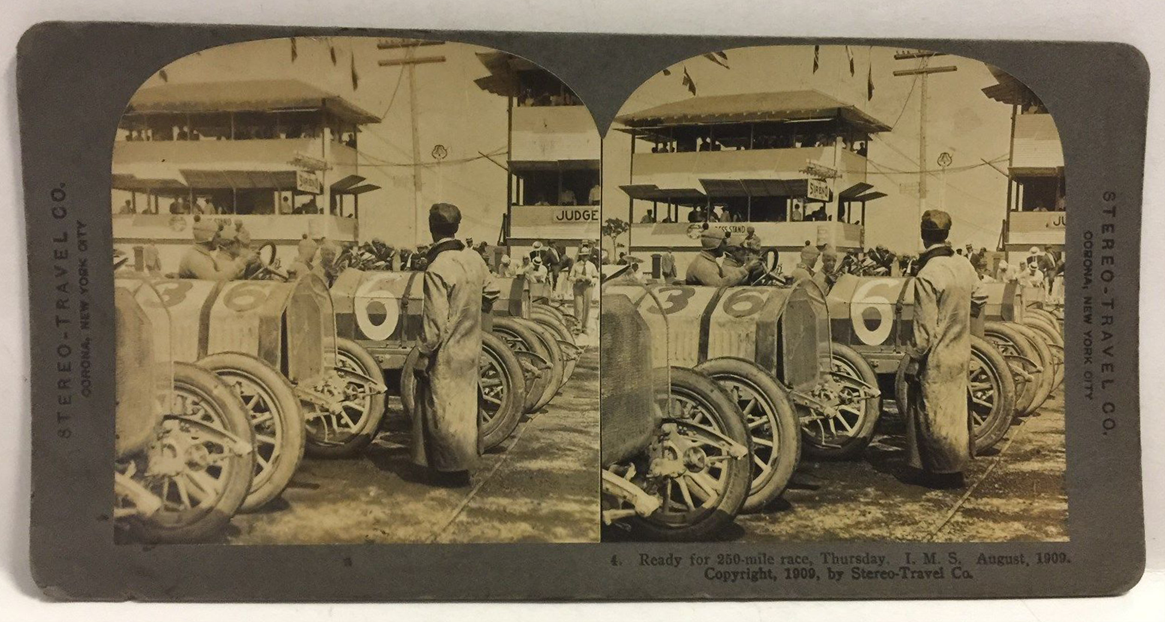
4. Ready for the 250-mile race Thursday. I. M. S. Races. August, 1909. (Lewis Strang Buick No. 36 in foreground, Thomas Kincaid National No. 6 adjacent)
Copyright, 1909, by Stereo-Travel Co.
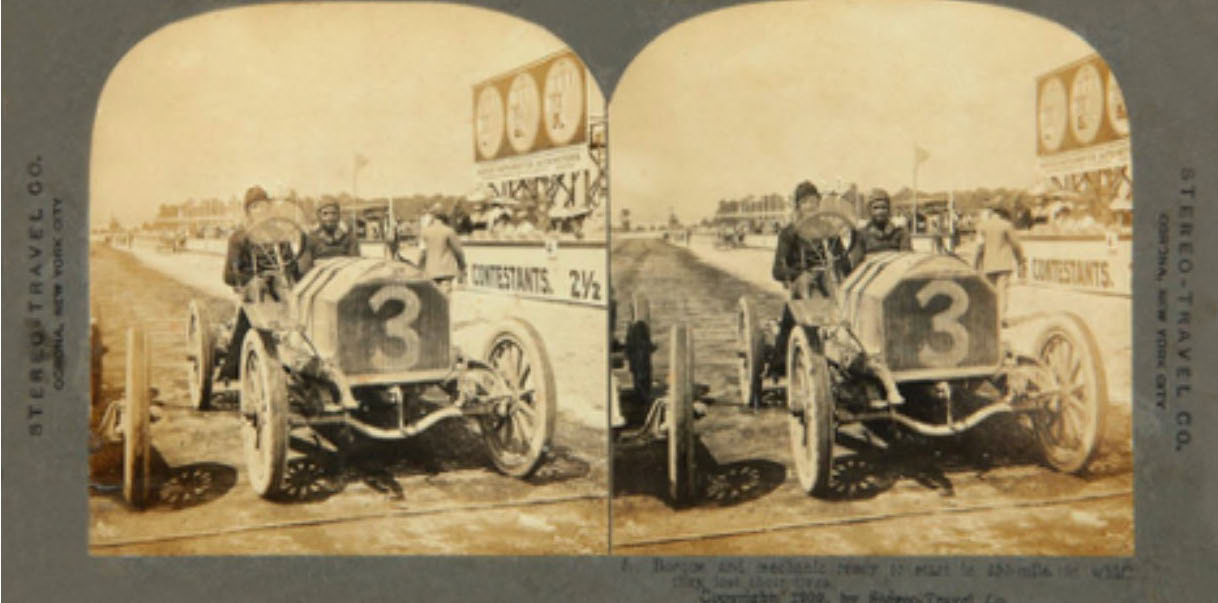
5. (William) Bourque and mechanic (Harry Holcomb) ready to start in 250-mile, in which they lost their lives. (Thursday August 19 in Knox No. 3)Copyright, 1909, by Stereo-Travel Co.
6. Start 50-mile Friday I. M. S. Races. August, 1909.
Copyright, 1909, by Stereo-Travel Co.
7. (Louis) Chevrolet (Buick No. 37) in 250-mile race. Thursday.
Copyright, 1909, by Stereo-Travel Co.
8. Stoddard-Dayton, (Louis) Switzer in 50-mile, Friday. (Race winner)
Copyright, 1909, by Stereo-Travel Co.
9. Finish 5-mile Friday, Nationals 1st and 2nd.
Copyright, 1909, by Stereo-Travel Co.
10. Stopping for repairs. I. M. S. Races. August, 1909.
Copyright, 1909, by Stereo-Travel Co.
11. Start 10-mile Free-for-all. Friday.
Copyright, 1909, by Stereo-Travel Co.
12. Start 100-mile. Friday; Buick (No. 36), (Lewis) Strang, won. Time 1 hour 32 min. 48 ½ sec.
Copyright, 1909, by Stereo-Travel Co.
13. First lap 100-mile. Friday. I. M. S. Races. August, 1909.
Copyright, 1909, by Stereo-Travel Co.
14. “In the Stretch.” Marmon and two Buicks.
Copyright, 1909, by Stereo-Travel Co.
15. Grand Stand, Judges, Stand, etc. I. M. S. Races. August, 1909.
Copyright, 1909, by Stereo-Travel Co.
16. Vast crowds lining fences. I. M. S.
Copyright, 1909, by Stereo-Travel Co.
17. Guardians of the track.
Copyright, 1909, by Stereo-Travel Co.
18. Marmon (Bruce Keene No. 17) in 15-mile, Saturday.
Copyright, 1909, by Stereo-Travel Co.
19. (Spectator) Cars in parking space. I. M. S.
Copyright, 1909, by Stereo-Travel Co.
20. Getting ready – 10-mile Amateur, Saturday.
Copyright, 1909, by Stereo-Travel Co.
21. Starting 10-mile Amateur, Saturday. (Eddie Hearne Fiat No. 24 in foreground)
Copyright, 1909, by Stereo-Travel Co.
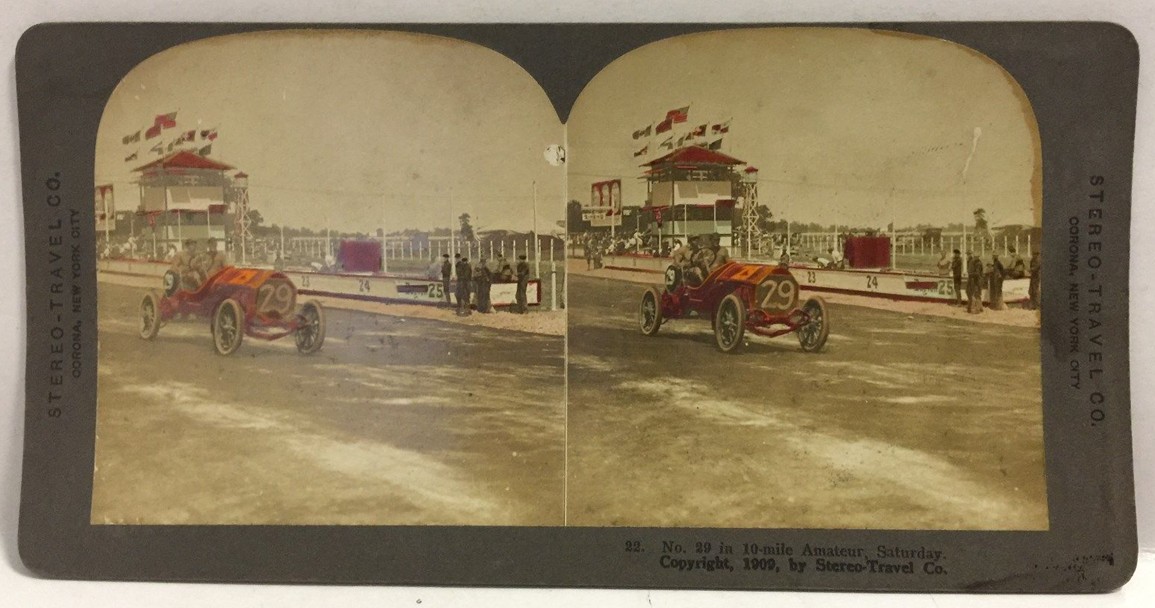
22. No. 29 in 10-mile Amateur, Saturday.
Copyright, 1909, by Stereo-Travel Co.
23. Fiat (No. 23), (Eddie) Hearne, winning 10-mile Amateur, 9 min. 44 3/10 sec.
Copyright, 1909, by Stereo-Travel Co.
24. (J. Walter) Christie’s world-beater. Record one mile in 18 7/10 sec.
Copyright, 1909, by Stereo-Travel Co.
25. Waiting call to race. (2 Marmon – Ray Haroun no. 16 visible in foreground, Stillman No 15 behind)
Copyright, 1909, by Stereo-Travel Co.
26. (Barney) Oldfield (Benz No. 27) winning 25-mile. Broke all records from Vanderbilt (?) to 25 miles. Time, 21 min. 21 7/10 sec.
Copyright, 1909, by Stereo-Travel Co.
27. National (No. 6), (Johnny) Aiken, winning 15-mile. 13 min. 27 5/10 sec.
Copyright, 1909, by Stereo-Travel Co.
28. Watching them whiz by. I. M. S. Races. August, 1909
Copyright, 1909, by Stereo-Travel Co.
29. Start 300-mile race (Johnny Aiken National No. 8 in foreground), Saturday. I. M. S. Races. August 21, 1909.
Copyright, 1909, by Stereo-Travel Co.
30. National, (Johnny) Aiken (No. 8), lowering all records 25 to 100 miles. Time for 100 miles, 91 min. 41 9/10 sec.
Copyright, 1909, by Stereo-Travel Co.
31. Brush between Buick and (Herb Lytle) Apperson (No. 1) in 300-mile, Saturday. ($10,000 Wheeler-Schebler trophy race)
Copyright, 1909, by Stereo-Travel Co.
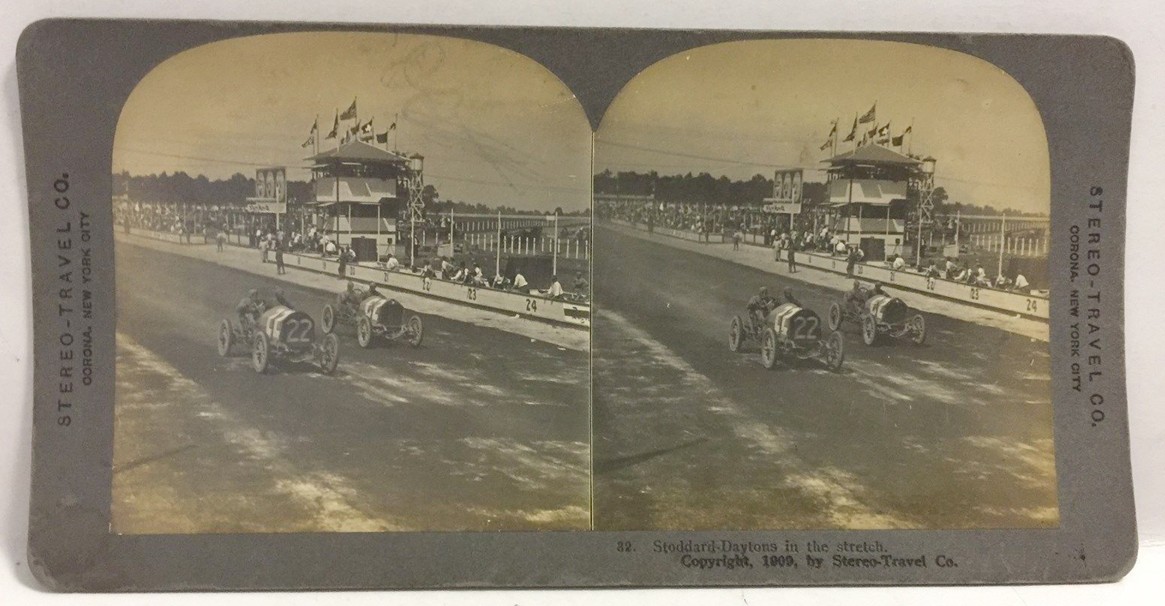
32. Stoddard-Daytons (No. 20 and 22) in the stretch.
Copyright, 1909, by Stereo-Travel Co.
33. Rushing down at 80 miles an hour. (poss. Lewis Strang Buick No. 46)
Copyright, 1909, by Stereo-Travel Co.
34. (Bert) Miller (Stoddard-Dayton) and (Lewis) Strang (Buick No. 46) fighting for the lead.
Copyright, 1909, by Stereo-Travel Co.
35. 37,000 people saw Saturday’s races.
Copyright, 1909, by Stereo-Travel Co.
36. “Don’t go near the tack.” (Guardsman posed next to track rail)
Copyright, 1909, by Stereo-Travel Co.
37. Crowds on the Bleachers.
Copyright, 1909, by Stereo-Travel Co.
38. At the half-mile. 300-mile, Saturday. ($10,000 Wheeler-Schebler trophy race)
Copyright, 1909, by Stereo-Travel Co.
39. Coming down the back stretch, 300-mile, Saturday. ($10,000 Wheeler-Schebler trophy race)
Copyright, 1909, by Stereo-Travel Co.
40. Jackson, two Buicks and Stoddard-Dayton at the mile. Middle 300-mile. Saturday. ($10,000 Wheeler-Schebler trophy race)


Comments
Great mystery photo! The track is Indianapolis Speedway and the race was August, 1909. The Stereo-Travel Company produced a set of 40 stereo cards documenting the first automobile races at Indy. The attached documentation provides more detail and the source (.(JavaScript must be enabled to view this email address)) has compiled a list of all 40 cards (I’ve included stereo card #36 of which the mystery photo is marked). Other attached photos are from the Detroit Public Library Digital Collection and clearly show the wooden building, fences and trees in the mystery photo. Tents are shown which aren’t in the mystery photo so presumably the tents were put up a few days after the mystery photo was taken. The Guard is a member of the Indiana National Guard.
Photos from the DPL Digital Collection.
The photo was made in 1909 at the Indianapolis track. The little house, seen here seemingly standing alone, was part of an area with tents used by the different competing teams for workshop and garaging. Uploaded a few photos from the opposite direction of the same building with the tents behind. It is clearly all very new, looking at the young trees and their support structure. The photos were made by Spooner & Wells. Many more can be found in the automotive collection of the Detroit Public Library.
The track was built in 1909 and the inaugural races took place from 19 to 21 August of that year. So the photos will date from that weekend or shortly before.
This is photo #36 of 40 taken during the very first race at the new Indianapolis Motor Speedway August 19th - 21st, 1909 prior to the speedway being paved with bricks. The Stereo-Travel Co. of Corona, New York City produced 40 stereoviews of the opening race meet. The bottom right of the stereoview says “Don’t go near the track” with a copyright of 1909. Place the stereoview card in a stereoscope which will presents two slightly different images separately to the left and right eye of the viewer. These two-dimensional images are then combined in the brain to give the perception of 3D depth. 3D photos! Attached is my overview of the first Indianapolis Motor Speedway race meet.
Click here to Download this file
The Stereo-Travel Company was a specialty photography company that produced images for use in a device called a stereoscope or stereo viewer. There were many companies that produced them from around 1890 - 1915 and when placed in the viewing device (see attached photo) allowed the user to see it in 3-D. They were usually sold in sets of between 50 and 100 cards for each topic. The Stereo-Travel Co. issued a set in 1912 related to the Indianapolis Motor Speedway so I’m guessing this mystery card is from that set which probably included scenes from various events held there from 1909 through 1911.
The track is too wide to be anywhere on the Motor Pkwy, but it is a racetrack nonetheless. The guardrails and posts are of later design with improved impact resistance. I believe this is after 1908. Photo is captioned “Corona, New York City,” but I am unaware of any racetrack in early Corona, Queens. The closest racetrack to Corona that comes to mind was in Brooklyn, just northeast of Coney Island. Amazing detective work on this solved mystery. Looking forward to this week’s comments
The track is the one in Savannah, Georgia operated by the Savannah Automobile Club. The photo was taken in 1908 in conjunction with the first Grand Prize Race of America. The Irish Volunteer Guards were hired to help with crowd control, They were actually issues ammunition for the rifles. There is a distant connection with the Vanderbilt Cup Races. That year the European Race Organization asked Vanderbilt to run the Vanderbilt Cup Race under their regulations, Vanderbilt didn’t have a problem with that but the Automobile Club of America, the sponsor of the Vanderbilt Cup races, said no. But they agreed to the formation of the new Grand Prize Race the first of which was held in 1908 at Savannah. ( I forgot who won). My guess that the notation of Vanderbilt Cup Race on the card was made when there was a possibility that Vanderbilt would agree to change the name of his race. I think not.
Hi Howard: Did you receive my reply and attachment to the sterescope “Guard” photo Sunday morning?
Thank you. Ken Paarrotte