Hemmings.com: Before Lucid’s Four-Door Dream, There Were Tuckers
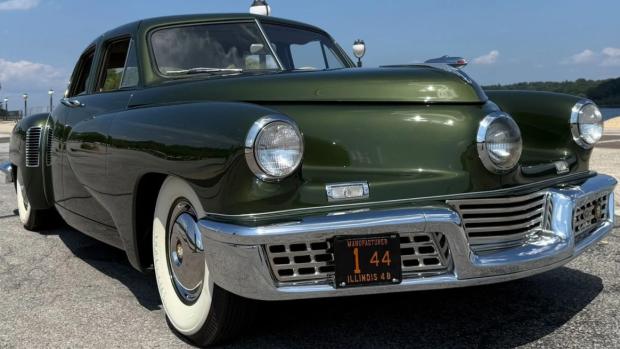
Tyler Roland of Hemmings.com has a new article featuring Tucker #1044.
Greg O.
Before Lucid’s Four-Door Dream, There Was Tucker's

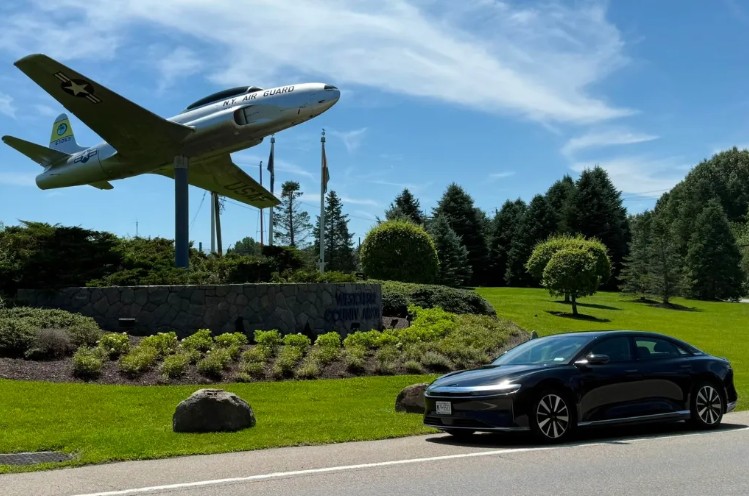
You may have heard that Lucid, the American manufacturer of the Air, a superlative EV sedan, is not doing too hot. Stocks have plummeted. They’ve downsized their workforce multiple times, and COO Marc Winterhoff was let go earlier this year. Their juggernaut of an SUV (some may say minivan), the Gravity, now augments the Air, and they have three more non-sedans joining their lineup – the Cosmos, the Earth, and an unnamed third vehicle – coming out in the near future.
When people think of an “EV sedan,” they’ll likely imagine the Tesla Model 3, but the further-upmarket Model S is the Big Bang. Tesla would still be an odd niche, and the entire automotive industry might not have embraced electric power, if it weren’t for the S. It’s entering its final days after over a decade on sale, making a bigger impression than any other 21st-century car.
The Lucid is better than the Model S, and has the critical acclaim to prove it, but it seems like no one cares.
Step back in time to the 1940s, and Preston Tucker had a fire of ingenuity as bright as Lucid’s. His four-door vision promised a car at the forefront of the American market. The Tucker 48 was ballyhooed as the most incredible car of its day in breathless ads. Today, just as prospective customers flocked to place orders then, people care. In a big way, too: Tuckers currently trade for seven figures.
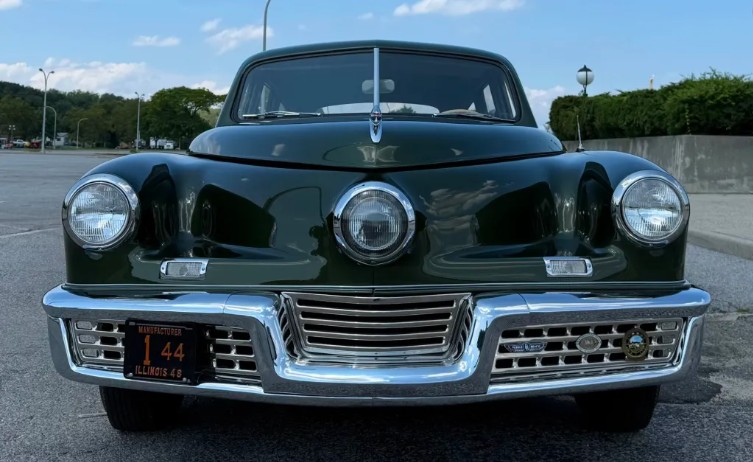
When the three-lighted sedan hit the scene, promotion proclaimed the 48 to be the “first completely new car in 50 years!” The initial powertrain commanded some of that excitement. The Tucker was slated to have a flat-six engine with a whopping 589 cubic inches of displacement – almost ten liters. 150 horsepower and 450 lb-ft. of torque would deliver brisk acceleration, like the instant torque of the Lucid decades later. Other advancements included further illumination from the “third eye” headlight and disc brakes, not mere drums.
Reality bites. The all-new 9.7-liter engine idea was cast aside, and an existing, helicopter-derived, 5.5-liter Franklin flat-six took its place. Drum brakes are all around, not the pledged discs. The “third eye” headlight did indeed turn with the steering wheel, but only after the car’s pilot had locked into a turn, so it made no real difference.
Why Tucker failed is the subject of a completely different article than this one – maybe a whole book. If you’ve seen the film Tucker: The Man and His Dream, you’ll know about the lawsuit. While Tucker was ultimately acquitted, the verdict couldn’t remove the stain on his name. The Tucker is a story in itself; it can carry written pieces like this, for which I managed to get time inside both a top-line Lucid Air Sapphire and a fabled 48.
Both the 48 and the Air are big inside. Lucid’s debut model packs its interior quite cleverly; you get S-Class space, which surprises you once you step beyond the deceptively small exterior. The briefcase-sized motors put out 670 horsepower. Buyers will love the frunk space and, for that matter, the range. Buy a Grand Touring, and you can expect just over 500 miles of driving between charges. All of this outside-the-boxness echoes what Preston Tucker wielded in front of the Detroit big boys.
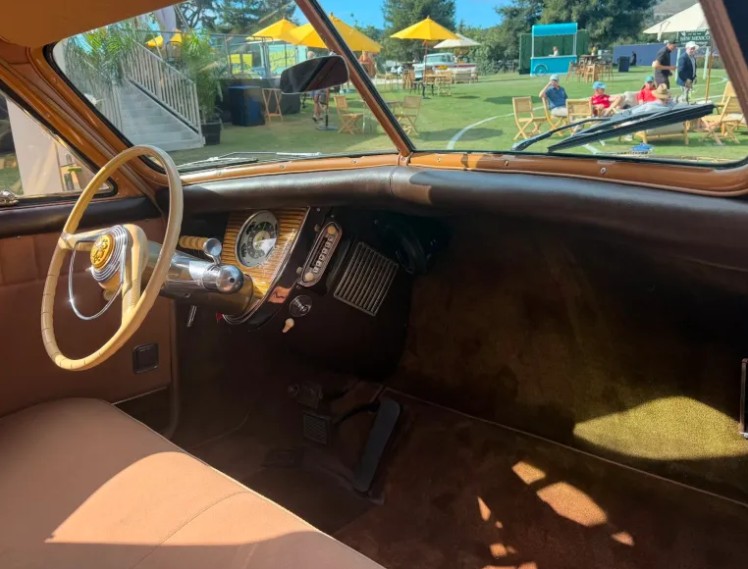
The 48’s interior, as you’d expect, is more minimal than the Lucid’s. To get the car moving, you’ll find another compromise, a transmission lifted from Cord rather than a “Tuckermatic” (only one Tucker today sports this primitive three-speed automatic). Check out the column shifter, which looks a bit like a vending machine’s coin receptacle. It’s a preselector gearbox, meaning you slot into gear, then floor the clutch pedal. You’re free to preselect a gear several seconds before shifting, if you desire. There’s no tachometer, so perhaps the preselector is closer to an automatic (or, indeed, Tuckermatic) than a manual.
No car on sale today has a preselector, or in the words of Dana Williamson, Director of the Collection at the Petersen Automotive Museum, a “piece of s***.” Besides Cords and Tuckers, these preselectors were fitted to other vehicles, from tiny Goggomobils to armored Daimler Ferrets; they weren’t unheard of in the 20th century. In 2026, a preselector feels more like a proposed innovation with good intentions basking in the umbra of progress.
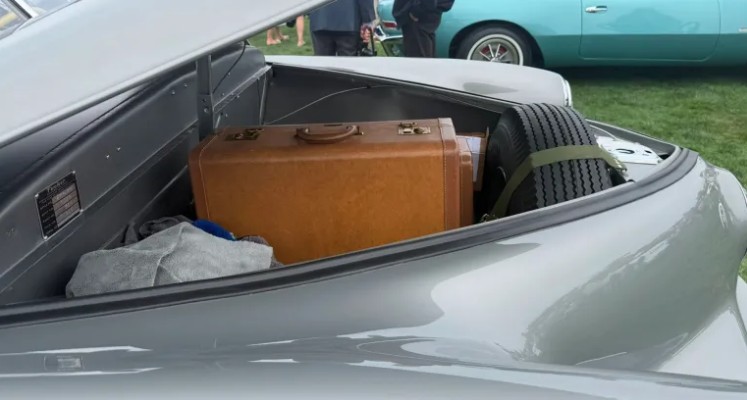
The controls in the spacious cabin are driver-centric, leaving immense room for whoever’s riding shotgun. Safety features are present, but no seatbelts; back then, they were seen as a sign the car was unsafe. Speaking of space, due to the engine’s placement in the stern, the Tucker sports a sizable frunk – just like a Lucid.
I’ve had haircuts that were harder to schedule than a Lucid Air demo drive. That was true in 2023, and it is arguably even more so now. I got behind the wheel of a Touring, which slots in between the Grand Touring I drove in 2023 and the base Pure. At the time, I did not know I would also drive the ballistic Sapphire, an engineering marvel with 1,234 horsepower and a $250,000 price tag.
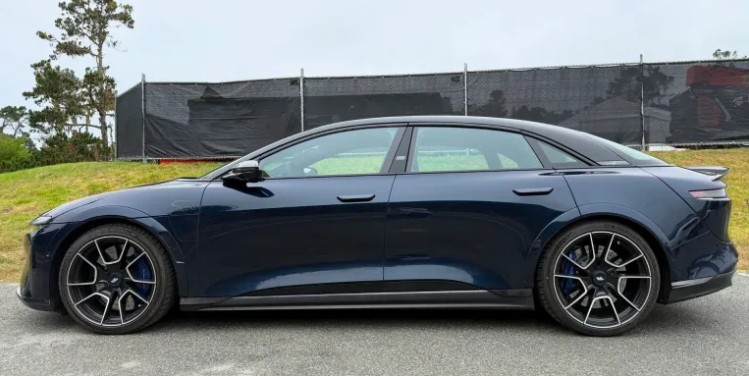
Prospective buyers can’t try the Sapphire, but I did. Lucid had some Sapphires available at Monterey Car Week for folks gearing up for Pebble, and I took my opportunity. As you might imagine, I was not cleared to launch all 1,200-plus horses. Truly, I don’t think I broke 40. Take away the speed and acceleration, and the $250,000 Sapphire feels no different than lesser Airs. You’re not paying the premium for anything beyond the vomit you’ll release after flooring it. The Touring has “just” 620 horsepower, around half of the Sapphire, but it can still dispatch you to cop-baiting speeds in a blink. Everyone goes on and on about the instant-download quality of EV speed. You’ve heard it all before, and the proto-Lucid Tucker is not speedy, so I’ll leave it there.
The Sapphire’s interior has plenty of alcantara, but otherwise is comparable to that of the Touring. Screens, an unfortunate synonym for “advanced thinking,” are up front and below the center console, but they’re less pronounced than the IMAX display in a Model S. You even have the option of folding the center screen into the dash to reveal a cubby. Nice. Maybe we’ve reached the end game of vehicle interior evolution when a hideaway screen (and buttons!) are a welcome sight.
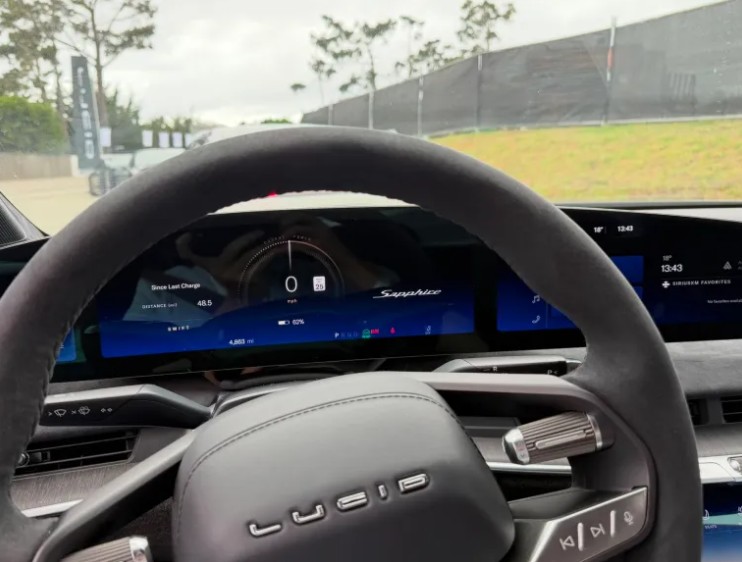
It’s pleasant behind the wheel of an Air. The wind noise I expected as a byproduct of EV silence may as well have been from a gale on another continent. It doesn’t cross your mind that this is made by a desperate brand, in the news for less-than-stellar goings-on.
Now for why you’re reading this…the Tucker.
It’s a little hard to explain to a non-car person why the Tucker is top-tier, crazy cool. Apart from the trio of headlights, they just have a late-‘40s/early-‘50s look to most people – very neat, but not heart-stopping. Plus, because of the manufacturing constraints and compressed development timeline, Tuckers aren’t (figuratively) miles ahead of typical cars from the era the way, for instance, a Duesenberg was in the ‘30s. Maybe it’s the English major in me, but the Tucker story packs a lot of weight into why I love it.
This year’s Pebble Beach Concours d’Elegance saw Matt Katz’s car take the field. He’s a Tucker nut to the core; in fact, his family has just named their pet dog “Tucker.” Having owned another Tucker previously, he traded up to the one at the Sunday show – #1029, one of a couple used for testing at the Indianapolis Motor Speedway and once utilized by Preston Tucker himself. The car went on to land a well-earned class win.
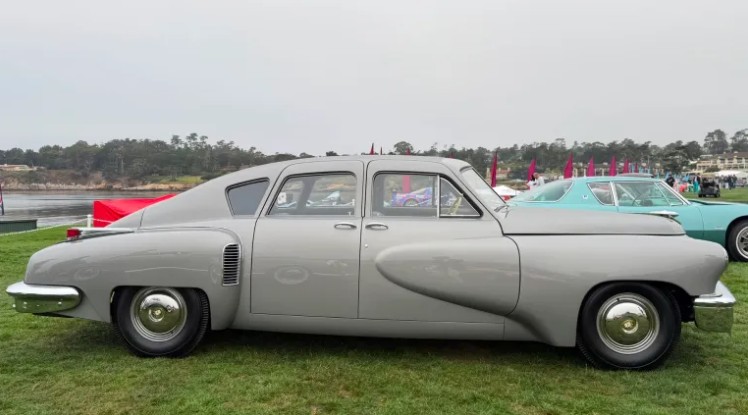
Katz, as you’d imagine, is smitten with the car, even though it fell short of the radical vision Preston put forward. “I’m not sure I would change anything. For the period, it was so advanced and ahead of its time. There is little I think he could have done differently, noting the extremely limited amount of time he had to build the 50 cars.”
My plan, at first, was to further talk to Katz about his Tucker affinity and get a ride after he completed the Tour d’Elegance on Thursday, but scheduling conflicts prevented that. Undeterred, I headed to the aftermath of the Quail event on Friday, because the Petersen Museum brought their Tucker up from L.A. Bonus: the Petersen’s is #1030, made directly after Katz’s car.
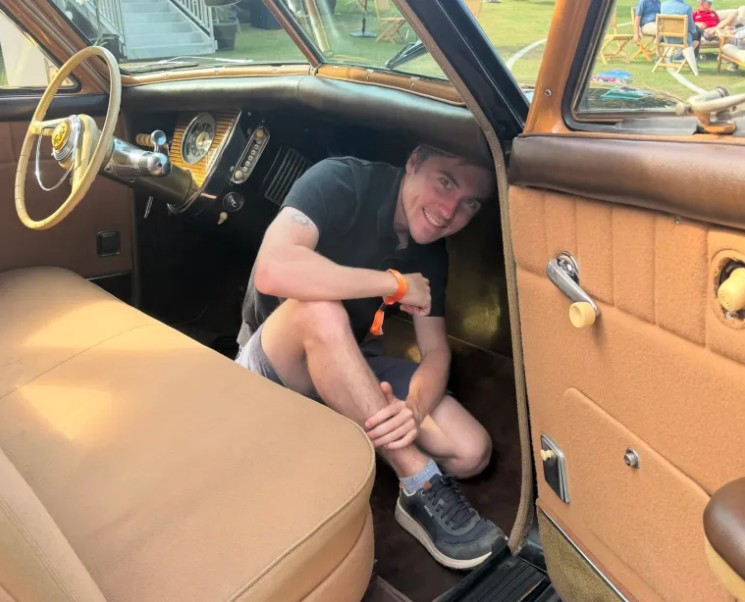
I got to sit in it. I got to crouch in the iconic “safety cell,” which fit me just so, as you can see here. I got to hear it fire up. But the bastard was stuck in second gear. (By the way, as I was looking around #1030, someone came up to talk to a couple of the Petersen folks, and remarked: “nothing from the era really excites me but this car.” Once again, the myth precedes the machine.)
After striking out two times, I started to get desperate. Tucker 48s don’t grow on trees. My Hemmings associate was adamant that I feel one of these cars in motion. Luckily, there’s a gentleman in New York, Howard Kroplick, who has a peerless taste in cars and a willingness to share them.
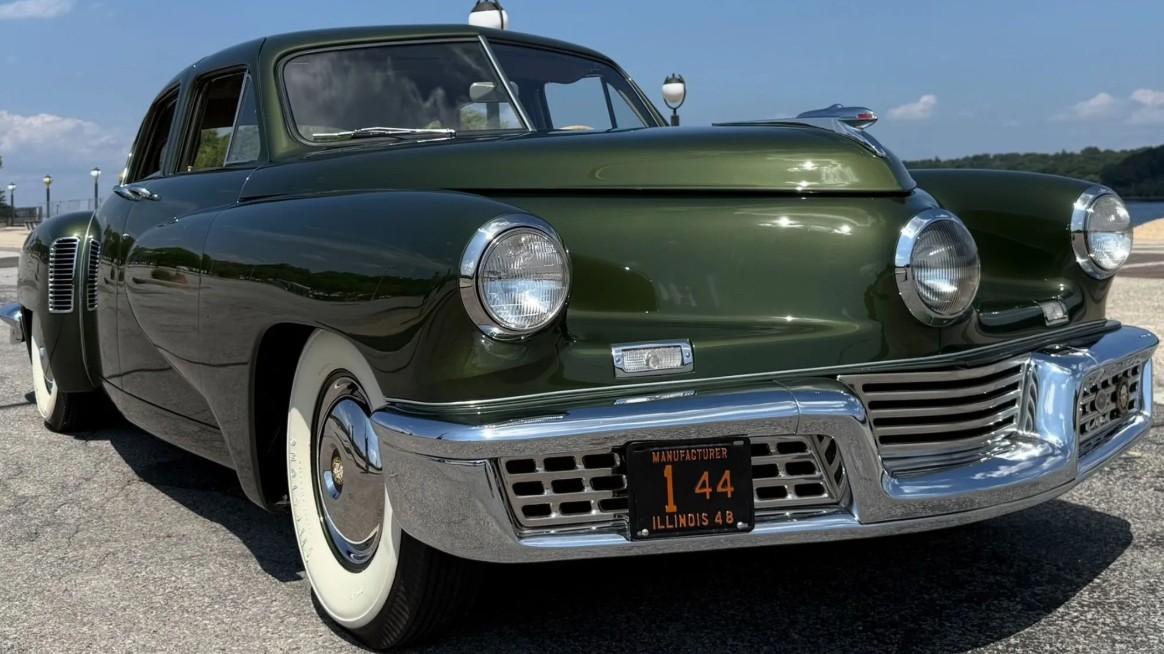
Kroplick has a small-but-mighty collection of vehicles, ranging from the “Black Beast” (a hair-raising race car which competed in the first-ever Indianapolis 500) to a futuristic curio intended for Domino’s Pizza delivery, the Tritan A2 Aero. Crucially, his stable houses a magnificent green Tucker, #1044.
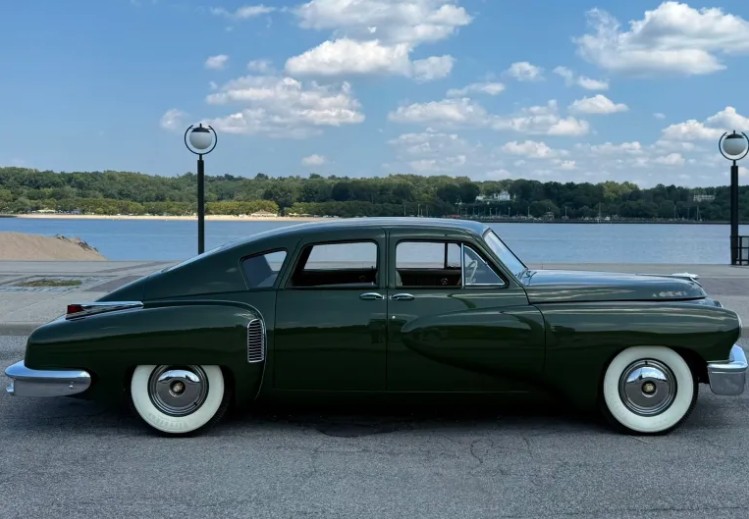
On the move, I noted a couple of things that alert you to this being no ordinary midcentury car: the engine rumbling far behind us, the space in front of me big enough to park a Volkswagen, and the action of the preselector. Unusually, Kroplick and his assistant, Dave Baum, would both rather have the preselector than not, even though it presented some fussiness on the way back from taking a few photos. Call it a dash of character, notwithstanding the fact that it was a transmission ten years out of date.
The ride, experienced on the identical front and rear bench seats, is somewhat bouncy. Tucker expert Mark Lieberman, who was with Katz and his car at Pebble Beach, says that’s the one thing he’d change – “further refinements on the suspension. It’s not as robust as I would like it to be.”
Parking and stepping out of the car lets you forget these little things and realize what you just did: ride in a Tucker. The context of the era, and how big a shockwave it detonated, comes back into your mind. While I sized up the Andante Green machine in an isolated parking lot by the water, it turned into a one-car show. Despite no one being around, somehow, a handful of passers-by approached us to ask about and admire the 48, mirroring the period clamor for the “first completely new car in 50 years.”
When I drove the Lucid Air Sapphire, my takeaway was that, without the “watch this!” glee of smashing the acceleration pedal and ripping 1,234 horsepower, you’re driving a classy car. There’s nothing telling you that you’re in the single best four-door sedan on the market. It’s all in the silent power. When I was on the road in the Tucker 48, my takeaway was that, without the lore and the Hollywood-worthy history running through your head, you’re driving a classy car from over seven decades ago. There’s nothing telling you that you’re in the four-door stuff of legends. It’s all in the story.


Comments
Good article comparing the Lucid Car company of today, with the Tucker Corporation of 1948.
The author needed that ride in Howard’s Tucker to finish his research before writing his article.Im sure he will never forget his ride in #1044.