Hagerty.com: Rob Ida Discovered DIY at Age 7 and Hasn’t Looked Back
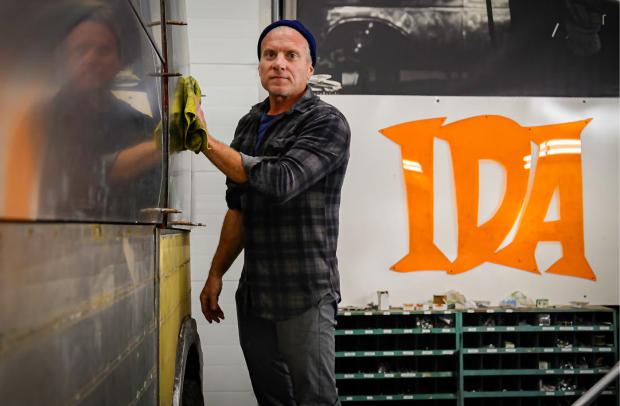
Sean Smith has posted this wonderful Hagerty.com profile on Rob Ida.
Enjoy,
Howard Kroplick
Rob Ida Discovered DIY at Age 7 and Hasn’t Looked Back
Sean Smith Hagerty.com
24 March 2025
“The first part of my life was about horses, not cars,” Rob Ida says. That’s a far cry from the career he’s built at Rob Ida Concepts, one of the world’s leading custom builders.
His grandfather Joe had come from Italy at age 13, started a gas station with his brothers in Yonkers, New York, then opened—and, sadly, closed—one of the first Tucker dealerships, his American Dream. After that entire enterprise went south, Joe eventually opened a service station in Brooklyn, where his son Bob worked as well. Then he moved the family to the wilds across the Hudson, searching for a better life.
“When my family moved to New Jersey, it was nothing but woods, and there was not much car culture, so my dad got into horses,” Ida says. “He was building a business and wanted to do something less dangerous. Everyone in the area was into horses, so he got into them.”

Naturally, young Rob got into them, too. Then, when he was 7 years old, he found a family scrapbook. “I remember it like it was yesterday,” he says. “I found a photograph of a car my dad built in Brooklyn in 1967 and raced at Raceway Park in Englishtown, New Jersey, in 1968.” This was a radical build. Bob had been running jacked-up gassers but wanted something small and lower to the ground, so he stuffed a blown Hemi engine into an Austin-Healey.
“This was a short-lived race car for my dad. He hit the gas at the line, stood it on its rear bumper, smashed it down, and threw it away. Realizing it was not the best race car, he decided to move on to something else.” The image of that car, however, burned itself into young Rob Ida’s brain. “When I found the picture of the Hemi-Healey doing a wheel stand, it just blew my mind. I thought, what is this? From that moment on, I didn’t care about horses. I only wanted to have cars. I was 110 percent into cars, and it was easy to get my dad involved again because that is who he was.”

Before long, Rob teamed up with his dad to build one. “I was all in. I would do anything to have a hot rod and be close to my dad.”
Bob Ida had a friend, Steve Mustakas, who had a Willys pickup, which Rob was quite fond of. “I hounded him and my dad. We had to have that pickup. My dad told me to call Steve to see if he would sell it. Steve is a fantastic guy. He negotiated with a 7-year-old and sold us the truck. That was our first father-and-son project.” A father-son-project that turned out to be a 10-second street car—no slouch in 1980.
“It was a wild build,” Ida says. “It had a blown big-block with a flip nose, wide-open headers on the side, and a parachute. It was a beast. We used to take it to Englishtown to the Nostalgia races but also ran it on the street.”
For a kid head over heels into cars, the new stuff never interested him. He only had an eye for hot rods and all the stuff from the past. “The vintage styling turned me on, so I always looked back. My dad was into big power and going fast, but not so much the styling. Not that he didn’t appreciate it. It wasn’t his major criteria. I was more into style than performance, but I certainly wasn’t against speed. So we made a good team.”
As has probably become apparent, Rob Ida wasn’t a typical kid. He didn’t really have the time or the inclination for little league or Boy Scouts. “I wanted to build a pickup of my own. The fact that I was eleven didn’t factor in. I thought I was like everyone else. I saw my dad’s friends building cars. Why couldn’t I?” The young Ida had a burning desire to figure it all out and then execute it. That was his education: doing things, making a lot of mistakes, working extra hard to make up for those mistakes, and working it out. “I got in there and got my hands dirty. I was all ears if I could benefit from someone teaching me.”
Bob Ida had a repair shop and towing business that he ran from his family’s property. Cars would accumulate in the lot and go unclaimed, and Rob viewed them in some way as his own. One car, a 1965 Pontiac LeMans with a 326 V-8, fueled his young dreams. “It had been abandoned in a garage, and the house had changed hands,” Ida says. “We were given the title and asked to tow it away.”
The block still sat in the engine bay, but the cylinder heads were in the trunk. Rob’s job was to reinstall the heads, the intake manifold, carburetor, and distributor, then make it run. “I wanted to do this myself. I didn’t want to stand there and watch my dad do it. But I was too small to get the parts from the trunk onto the block, so that was the only physical help I got. The rest was guidance. My dad and I would talk about it over dinner, and I would go out and execute it. With that help, I got it running.”
The car was in good shape overall, so Rob painted it, installed a radio, and changed the wheels. Then he got seat time driving it around the property. “Then somebody bought it,” he says, “even with the goofy flames I had put on it with a spray can.” But that gave him the chance to find more projects, so he bought some cars, did a little work (with his dad helping out as parts runner), and flipped them, which was an invaluable lesson in the business side of things. This all helped improve my confidence.”
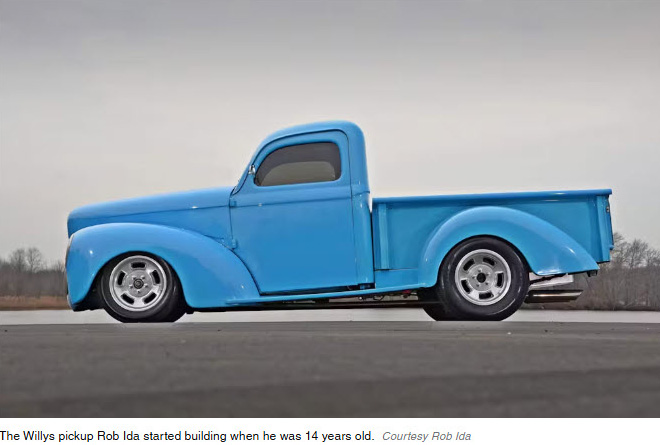
By the time he was 14, Rob still had Willys on the brain, and he got a line on some parts. “We heard someone had a Willys cab for sale. That was the beginning. I would build a Willys pickup for myself.” His dad drove him to a property full of cars and parts shoved into a chicken coop, and there sat the skeleton of a Willys pickup cab. “There was hardly anything there,” Ida says, so “we swapped him for a ’37 Ford grille. For the next three years, the Willys project consumed him. “My dad let me use all the tools so I could figure out how to make this happen.”
His dad’s junkyard, too, was fair game, and Rob made great use of it, channeling the old-school hot-rodding ethos like a champ. The chassis, for instance, was 1970s Toyota pickup he stripped down the frame rails, onto which he plunked the Willys cab. “I cut the front suspension off a Pinto and welded it onto my chassis. I got the rear disc brakes off a Lincoln Versailles and adapted them to the Ford 9-inch rear end I had, so I had four-wheel disc brakes. I used all the parts that were available to me. I never had a doubt. I knew it was going to get done.”
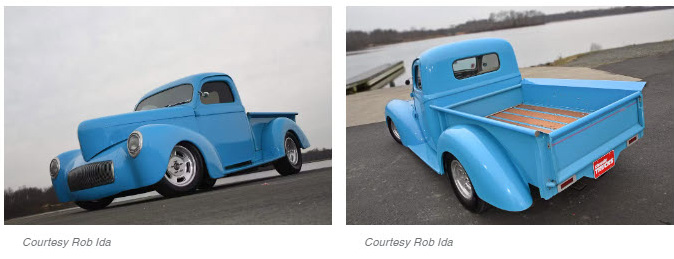
For three years, Ida plugged away. He learned to weld and to fabricate. He installed a firewall in the Willys, created floors, and made a bed. He built a custom air-conditioning unit. He learned to make seats—frames, straps, springs, the whole deal. He even sewed the leather for them himself, he says. When he needed more parts, he flipped more cars to raise money. And then, when we was 17, it was done.
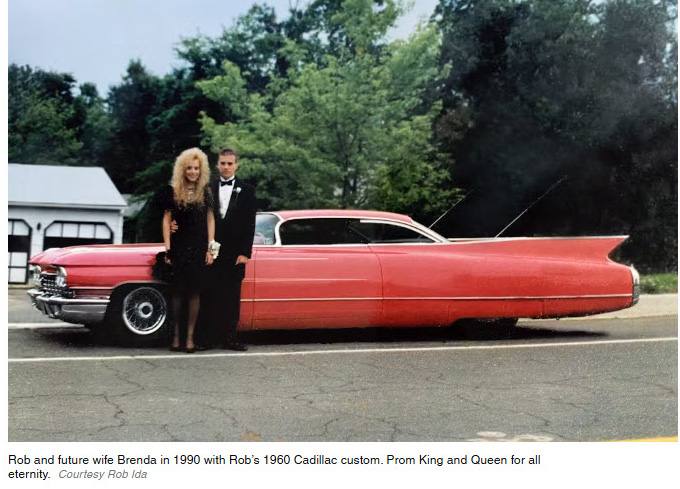
“I drove it on my first date with my future wife, Brenda” he says. “We have been together now for 34 years. We went on that date in March. It was an unseasonably warm day, which was good, as I didn’t have side windows yet. I was probably saving up for power window motors. But she loved it, even though nothing about it was comfortable.” For comfort, the drove his pink custom 1960 Cadillac to prom.
But he hung onto the Willys for about five years. Then he and Brenda decided to get married. “I wasn’t going to get married before I could afford to buy a house, though. I didn’t want to get caught up in a situation I couldn’t afford to be in.” At that point, Ida wasn’t sure if he could make money building hot rods, and for a while he considered going into architecture, because he’d always loved design. “But I didn’t follow that path.”
At 23, he sold the Willys and the Cadillac to pay for his wedding and put a down payment on a house. For a long time, the truck was never too far away, however, because the guy who bought it was local. He’d stop by to chat with Rob every so often. He passed away eventually, and Ida lost track of the truck. “I wasn’t feeling nostalgic. I was moving forward, not looking back, thinking of other things. I was working on building a business for a lot of years, and there were lots of weeks I didn’t take a paycheck.”
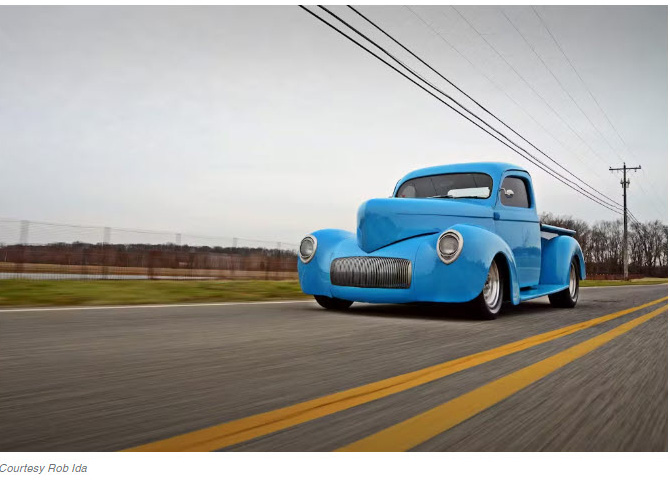
About six years ago, however, Ida got an email from a woman whose husband had been the most recent owner of the Willys pickup. “He was dying of cancer and had told her to get in touch with Rob Ida. ‘He would buy the pickup.'” Several months after he passed away, she reached out again. “I went and saw the pickup,” he says. “It was the same as I remembered it and still looked just like it did when I built it. It rattled the same. All the mistakes that 14-year-old kid built into it were still there. And the thing still worked. I couldn’t believe all the people who had driven it like that and didn’t think about reworking it.”
Ida bought it back and still owns it, though he doesn’t drive it much these days. “But when I do, it takes me right back to being 17. All the things that bothered me then are charming now. That’s why cars are so important to me. They’re like a time machine. You get in it, and it transports you back to a different time. A special time.”
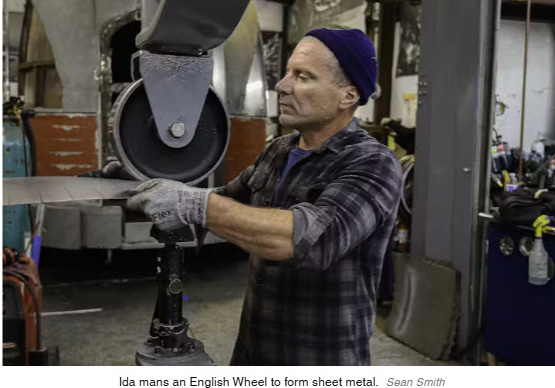
Sometimes, those kinds of escapes are necessary, because even for one of the world’s foremost hot rodders, the daily grind can wear thin.
“People often tell me you’re so lucky you do what you love,” he says. “Most times my answer is ‘I don’t love it’. Sometimes I hate it. But I am absolutely obsessed with it. I think if you love it, you’re not working hard enough. You have to be working at a level where you are pushing that envelope all the time. Find your limit, then go past it, if you want your next project to be better than the last one. You just can’t be doing the same thing over and over again.
To that end, Rob Ida is always looking forward. Each project at Rob Ida Concepts has to excite him and present a new challenge. Whether it’s a custom job or a restoration, the work has to interest him and push him in directions he hasn’t gone before. “Everything in the shop has some kind of emotional connection,” he adds. “It might be a vehicle a great client owns that has a deep meaning to them, or it has historical significance, or maybe we take on a project because we love the esthetics.”
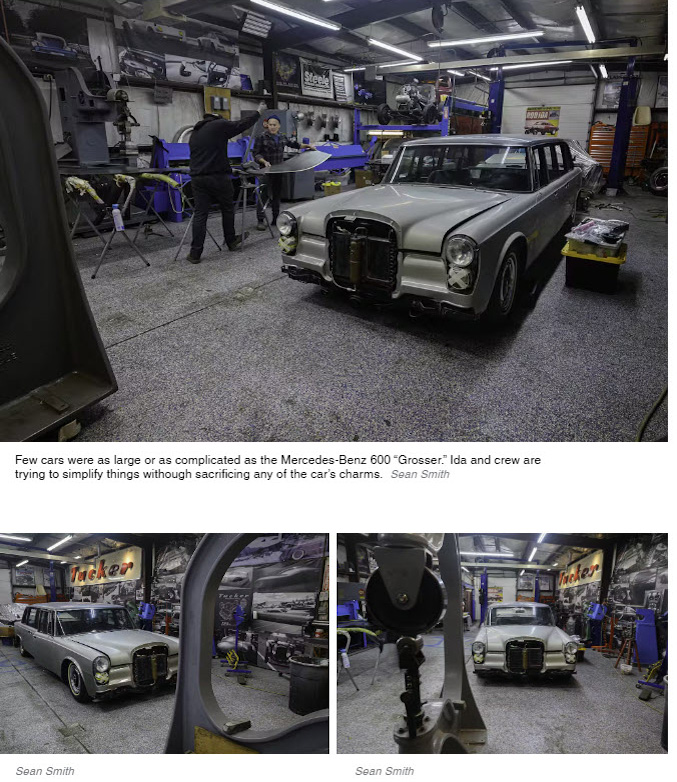
Two projects, particularly, have stretched Rob and his shop’s custom work to the max. One is a Mercedes 600 limousine, which they were given to reimagine. The ultra-luxurious 600, built from 1963 to ’81, was one of Mercedes’ most expensive and complex machines when new and remains so when it comes to restoration. It utilized a hydraulic system to run everything from the windows, seats, and sunroof to the boot lid and automatically closing doors. The compressor motor alone costs more than 10 grand. So, instead of stock, Ida and his crew went full custom. Everything is now electric. The four rear doors had pillars in the center, making getting in a project, so they created suicide doors for easy ingress and egress. The wraparound dash is totally digital, with a backup camera that a behemoth like this needs. Extra space was created for the ex-power lifter chauffeur to fit behind the wheel. There will be nothing else like it on the road when the work wraps up.
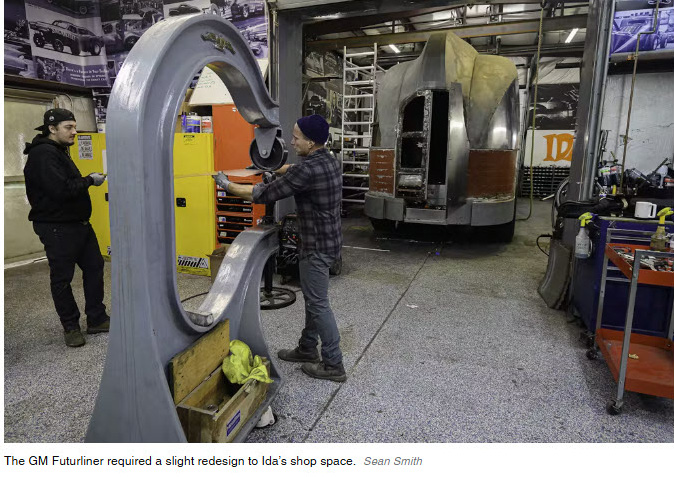
The other project is so challenging, Ida literally had to reconfigure his shop just to take it on. That would be the General Motors Futurliner he is currently restoring. “I had to replace my 10-foot door with a 12-foot one to get it in the shop. I also had to modify the heating system to get the headroom I needed.”
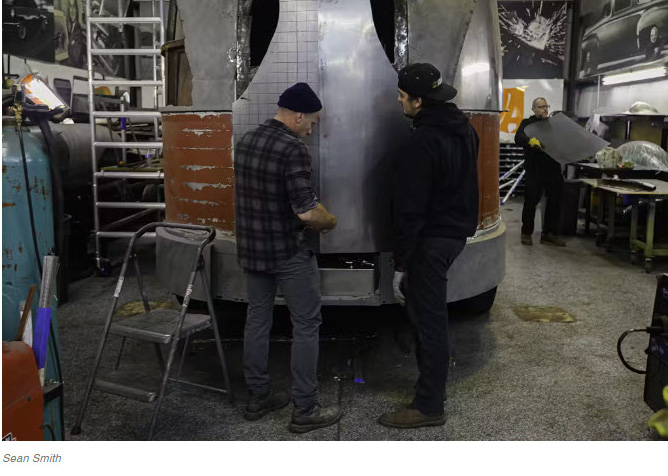
Twelve Futurliners traveled throughout the country prior to World War II as part of GM’s “Parade of Progress,” each with a diorama showing the modern world. There are eight remaining, four in the U.S. and four in Europe. “We’re returning this one to the spec Harley Earl initially designed in 1939,” Ida says. “Back then, the idea was to have a glass dome over the driver. It gave them a fantastic view and was a striking design. The problem was it would be blisteringly hot. It would be deadly for the driver. There was no ventilation, and the sun would be beating down on them. And Futurliners only went 30 miles an hour. That detail was scraped for obvious reasons. But this one won’t be used like that, so we want to return it to its original design. It will be the only one like that.”
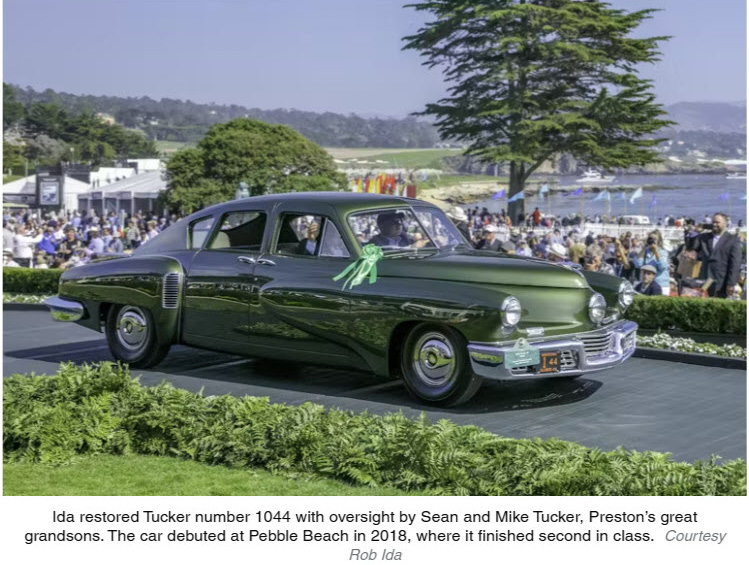
Curiously, the Futurliner project came about because Rob restored the client’s Tucker, which had been one of Preston Tucker’s personal cars. Nearly 80 years ago, Tuckers fueled the dreams of the Ida family in the car world. Since the age of 7, when he first traded horses for horsepower, Rob Ida has carried the torch.


Comments
Wow, and I thought I was young when I first started driving a 1933 Pontiac at age eleven. What a great story for an old car lover like me to read.