Mystery Friday Foto #48 Solved: An Interesting Motor Parkway Monorail Proposal
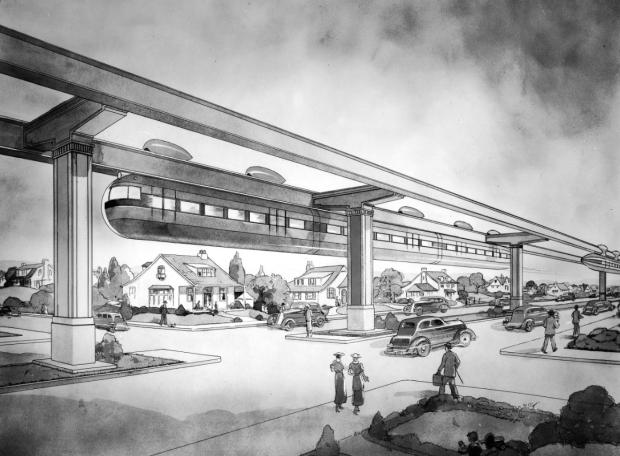
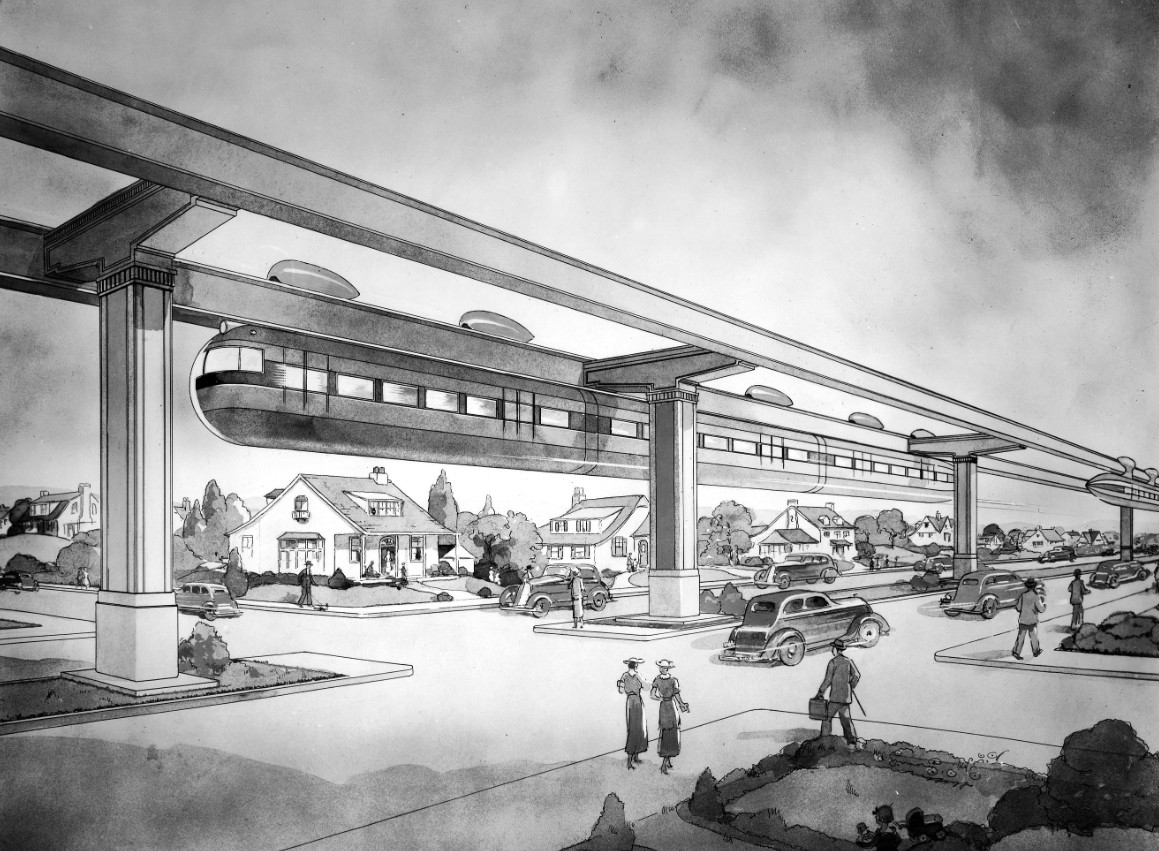
Did you identify this monorail concept drawing to hover over the Motor Parkway?
Identify;
- The interesting idea and purpose behind this proposal (The answer can be searched on this site)
In a May 2, 2009 post, it was detailed that the new and free, Moses highway system was causing less and less usage of the Long island Motor Parkway in the early 30's. Several suggestions for a repurposing of the Motor parkway were introduced with this hanging monorail system to be the most intriguing.
- Year of this proposal and who was behind it
The Queens Chamber of Commerce had brought forth this proposal in 1935. However, Willie K.Jr. couldn't imagine where the funding would come from and never took the project seriously.
- Where has this type of rail system been successfully used before?
This monorail is similar but yet very different to modern monorails, such as the monorail at Disney World. Whereas the Disney monorail rides above the rail, this proposal has the cars hanging (suspended) from below the rails. The genesis of this design goes back to the late 1800's, where, in 1901, the Schwebebahn was completed in Wuppertal, Germany. The Schwebebahn is still in use today and has even been modernized. The landmarked Schwebebahn is still a very dependable alternative to other types of monorails and traditional rail types of transportation of today.
Suspension Railway In Wuppertal: Story Of A Landmark
For movie buffs, another example of a 'hanging monorail' can be seen in the 1966 movie 'Fahrenheit: 451'. In 1966, François Truffaut filmed "Fahrenheit 451" based on the Ray Bradbury novel. Some shots were taken on the test track of the SAFEGE suspension railway (Société Anonyme Française d'Études de Gestion et d'Entreprises), which was built in 1958, in Châteauneuf sur Loire, France.The vehicle can be seen from the outside, while the interior shots were probably filmed in a studio. Guy Montag (Oskar Werner) and Clarisse (Julie Christie) exit through a ladder at the bottom of the wagon, which was designed as an emergency exit. In the following long shot, the wagon is seen moving back and forth in the background several times. The suspension railway is similarly seen in two later scenes. The test track was soon closed and the France SAFEGE never came to be, but two railways were built in Japan based on the SAFEGE system.
Fahrenheit 451 (1966) SAFEGE Monorail (Click this link-only available by watching on YouTube and not able to be embedded)
Art Kleiner of Kleiner's Korner expanded on some of the other types of transportation to utilize the flailing Motor Parkway including further documentation on the mystery photo monorail.
Kleiner’s Korner - Trains, Trolleys, Buses and Bicycles on the Motor Parkway
Comments (10)
Congrats to George Philippides, Steve Lucas, ErnieM, and Art Kleiner for identifying the unusual proposal. Kudos to Art for the further documentation.
Greg O.
Suspension Railway In Wuppertal: Story Of A Landmark
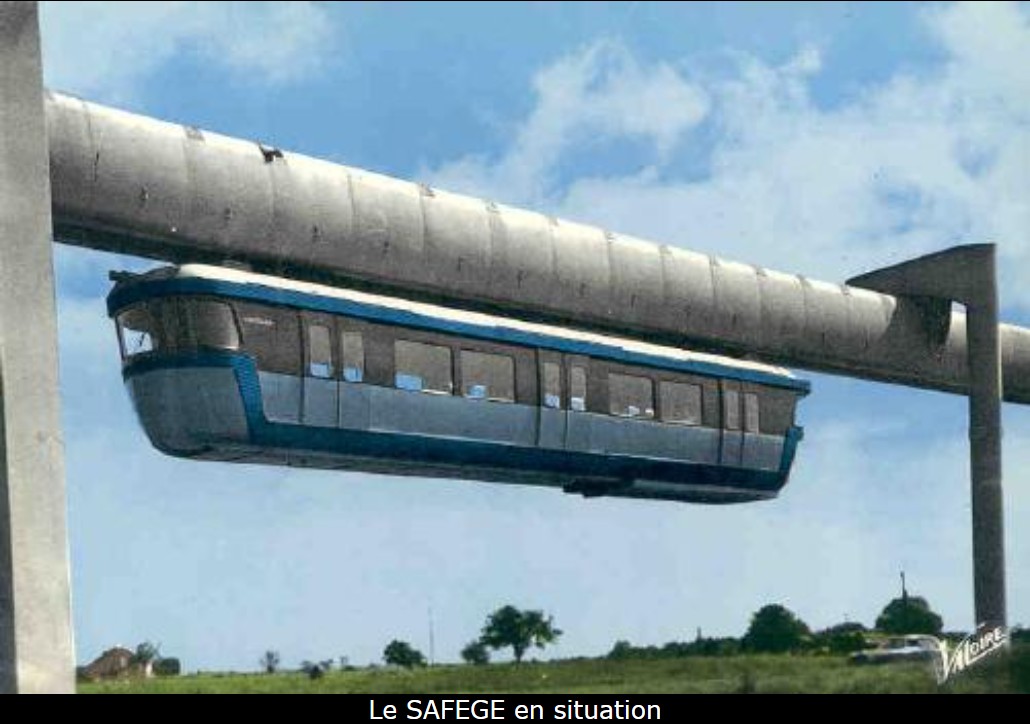
Le SAFEGE (test track used for the film 'Fahrenheit: 451"
Site translation;
The genesis of the French suspended metro, the Safège, dates back to the 1950s.A consortium of companies was created under the name SAFEGE TRANSPORT. Among the participants in the project were Renault (which would manufacture the vehicle), Michelin (for the tires), Alsthom (for the motorization), Baudin-Chateauneuf (which would handle the track), etc.It studies a new means of transport addressing several specific issues of urban transport.The SAFEGE in situation(c(c) SAFEGE TRANSPORT
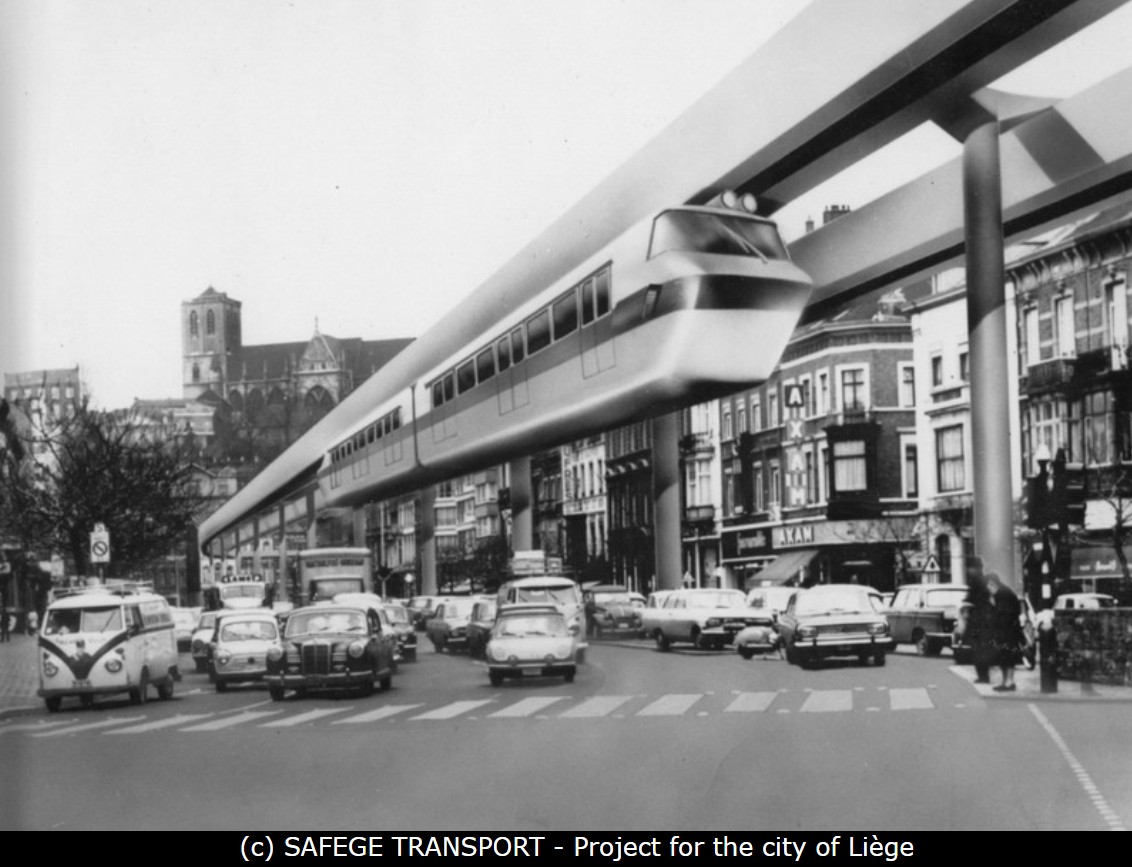
- Project for the city of LiègeAn elevated track facilitates access to cities because the ground footprint is limited.In the photo to the side, the Safège integrates perfectly into an existing intersection.Moreover, the viaduct allows for smoothing out the irregularities of the terrain. It improves comfort.There are no major infrastructure works required as is the case with the metro.The cost is therefore more competitive compared to a classic metro.
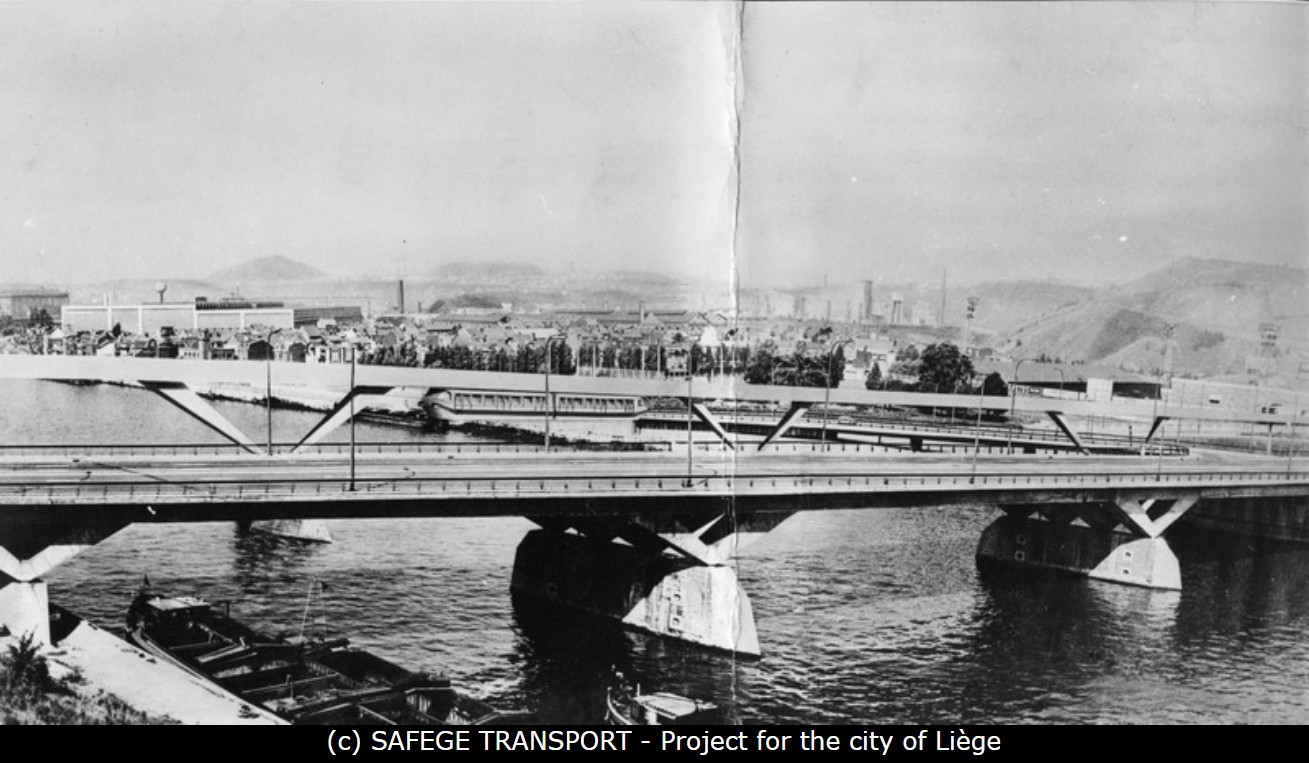
Example in the photo to the left with an example of river crossing (The Meuse). (c(c) SAFEGE TRANSPORT - Project for the city of Liège Cross-section diagram of the track The running surface being inside the monobloc track, it is perfectly protected from the elements (rain, snow, ice....). The grip of the tires is therefore assured at all times and in all weather conditions. Its design ensures that no obstacles can be present on the track. This eliminates any malicious acts, as well as any falls of persons or animals onto the track. The integration into the urban landscape was one of the cornerstones of the project SAFEGE still exists. It is now an engineering office of the Suez Environnement company. Thanks to SAFEGE, which we would like to thank here, we are able to present you with some unpublished documents about SAFEGE and its operations.


Comments
I did as you suggested and searched for “monorail” on this website. Found the great article from 2009. I’ll let everyone discover it for themselves. It is fascinating.
I’m almost certain that this type of “monorail” was already in use in Hamburg, Germany. However, as to who proposed the system for use in NY or LI, I can’t hazard a guess. Certainly not Robert Moses. But maybe just before the closing of the LIMP in ‘38, someone in authority proposed its use on the LIMP’s right of way.
Found the answer on this site.
In 1935 as the Great Depression and expanding NY state highway system made Long Island Motor Parkway less viable, the Queens Chamber of Commerce considered using the LIMP right of way to build an elevated monorail.
Similar system was built in Germany, the Schweberban and later at the 1965 NY Worlds Fair.
As the economic and practical usefulness of the LIMP was winding down in the mid 1930’s, a proposal was made by the Queens Chamber of Commerce in 1935 to build a monorail type public transportation system using the LIMP right-of-way. A similar system had been built in Wuppertal, Germany in 1901 and still operates to this day. Disneyworld’s monorail in Florida appears to be almost identical in design.
The interesting idea and purpose behind this proposal:
Queens Chamber of Commerce in 1935
https://www.vanderbiltcupraces.com/blog/article/saturday_may_2_2009_the_proposed_motor_parkway_monorail
Year of this proposal and who was behind it:
1935. Wiliam K. Vanderbilt Jr. never seriously considered the project due to the absence of funding.
Where has this type of rail system been successfully used before?:
Wuppertal, Germany, which began service in 1901 and is still in use today.
Disneyland also has a monorail
The 1964 Worlds Fair.
Also on Long Island: http://www.screanews.us/ScreaNews/ScreaNews1003/MonorailEastPatchogue.htm
Looks like a proposal for a monorail for the 1939 world’s fair I don’t have the talent to look it up but did Raymond Lowey design it? It looks like his style JeRita
On second look was it a plan for mass transportation to Long Island. We could sure it it today on a Friday commute east and westbound on Sunday.
A monorail was proposed to help alleviate traffic and rapid transit problems in Queens, Nassau and Suffolk.
Proposals for the monorail were presented by a private concern to the Queens Chamber of Commerce in July, 1935 for the Queens portion - around the same time, John J. Halleran, Commissioner of Public Works for Queens issued a statement urging building a monorail along the Motor Parkway and the Executive Vice-President, William J. Russell of the Queens Chamber of Commerce, requested a meeting with Willie K. to discuss the Motor Parkway and the proposed monorail.
The first monorail, the Schwebebahn, opened in Germany on March 1, 1901 and is still in use.
More documentation
One more set
And speaking of alternative means of transportation . . . I found this early 20th century colorized postcard from Nellie showing how Woodhaven might look in the future, including a monorail overheard! I found it quite interesting.
https://youtu.be/rXiwn7v0UlA?si=-mjk4Ib8JDscKNiB